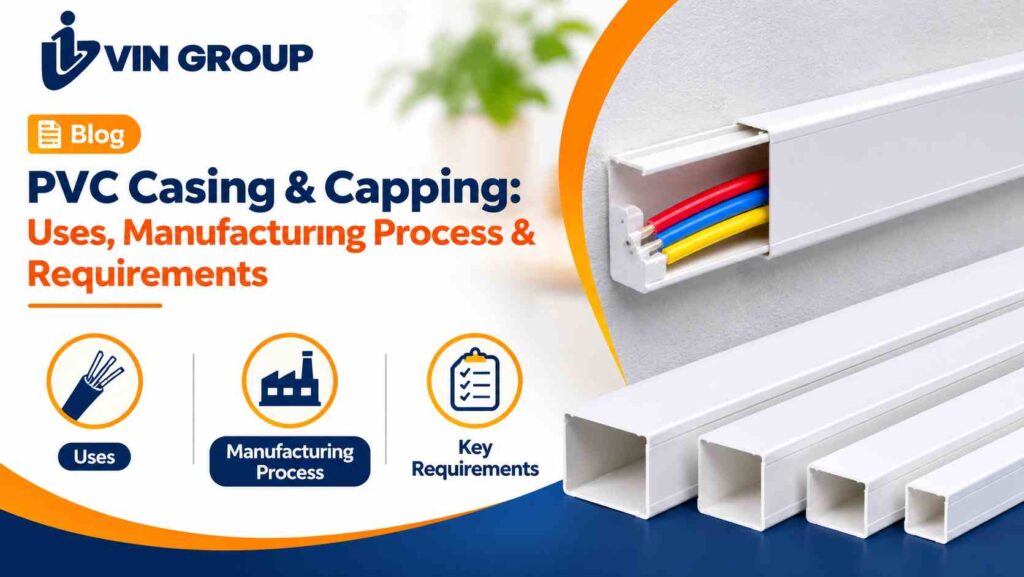
PVC Casing & Capping: Uses, Manufacturing Process & Requirements
PVC casing and capping are widely used in electrical installations to protect and organize electrical wiring in residential, commercial, and industrial buildings. These products provide a practical solution for covering exposed electrical wires while maintaining a neat and organized appearance.
Polyvinyl Chloride (PVC) is commonly preferred for casing and capping manufacturing because of its durability, electrical insulation properties, lightweight structure, and ease of processing.
For manufacturers, selecting the right raw materials and processing additives is important for achieving consistent product quality, smooth surface finish, and efficient production.
What Is PVC Casing & Capping?
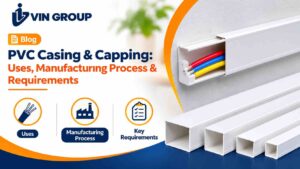
PVC casing and capping are electrical wiring management products manufactured using rigid PVC compounds.
- PVC Casing: A rectangular or square-shaped channel designed to hold and organize electrical wires.
- PVC Capping: A removable cover fitted over the casing to protect and conceal the electrical wires inside.
Together, they provide an organized wiring system and help protect electrical cables from dust, accidental contact, and minor external damage.
Major Uses of PVC Casing & Capping
PVC casing and capping are used in different types of electrical installations.
1. Residential Buildings
They are commonly installed in homes and apartments to organize electrical wiring along walls and ceilings. They are useful for surface wiring installations where concealed wiring is not practical.
2. Commercial Buildings
Offices, retail stores, educational institutions, and commercial spaces use PVC casing and capping to manage electrical cables and maintain organized interiors.
3. Industrial Applications
Industrial facilities may use suitable PVC casing and capping products for organizing wiring in selected areas, subject to electrical, mechanical, and environmental requirements.
4. Renovation and Electrical Upgrades
PVC casing and capping are useful when additional wiring needs to be installed without extensive wall cutting or structural modifications.
5. Cable Management
They help organize multiple electrical wires, reduce cable clutter, and provide a neat appearance in different installations.
PVC Casing & Capping Manufacturing Process
Manufacturing PVC casing and capping involves several stages, from raw material preparation to final product inspection.
1. Raw Material Selection
The first step is selecting suitable PVC resin, stabilizers, lubricants, processing additives, pigments, and other formulation ingredients.
The quality and compatibility of these materials influence the final product’s mechanical properties, surface finish, colour consistency, and processing behaviour.
2. PVC Compound Mixing
Selected raw materials are mixed according to the required formulation using suitable mixing equipment.
Proper mixing helps distribute additives and other ingredients throughout the PVC compound, supporting consistent processing and product quality.
3. PVC Extrusion
The prepared PVC compound is fed into an extrusion machine. Heat and mechanical force soften and process the material before it passes through a specially designed die.
The die gives the material the required casing or capping profile.
4. Cooling and Calibration
The extruded profile passes through calibration and cooling systems to maintain the required dimensions and shape.
Controlled cooling helps the product retain its profile and dimensional accuracy.
5. Cutting and Finishing
After cooling, the continuous PVC profile is cut into the required lengths. Edges and surfaces are checked for defects, and products are prepared for packaging.
6. Quality Inspection
Finished PVC casing and capping products are inspected to verify dimensions, surface quality, colour consistency, fitting, and other relevant performance requirements.
Key Performance Requirements of PVC Casing & Capping
Manufacturers must consider several important parameters to produce reliable PVC casing and capping products.
1. Dimensional Accuracy
Consistent width, height, thickness, and profile dimensions are essential for proper fitting and compatibility between the casing and its cover.
2. Mechanical Strength
The product should have suitable rigidity and mechanical strength to withstand normal handling, installation, and service conditions.
3. Surface Finish
A smooth and uniform surface improves product appearance and supports a professional finish. Surface defects, roughness, and uneven extrusion should be controlled.
4. Colour Consistency
Uniform colour throughout the product is important for maintaining visual quality, particularly in commercial and residential installations.
5. Impact Resistance
PVC casing and capping should have suitable impact resistance for their intended applications and operating environments.
6. Dimensional Stability
The product should maintain its shape and dimensions under specified manufacturing and service conditions.
7. Processing Efficiency
Stable extrusion, suitable material flow, and consistent lubrication are important for maintaining production efficiency and reducing manufacturing defects.
Role of Lubricants and Processing Additives in PVC Casing & Capping
Lubricants and processing additives play an important role in rigid PVC extrusion.
They help manage friction between the PVC compound and processing equipment, influence material flow, and support extrusion stability.
Selecting an appropriate additive system can help manufacturers evaluate improvements in:
- Extrusion and processing performance
- Material dispersion
- Surface smoothness
- Product consistency
- Overall additive cost efficiency
The right additive selection depends on the PVC formulation, equipment configuration, processing temperature, and production requirements.
CS Ultra™ – Calcium Stearate Replacement for PVC Processing
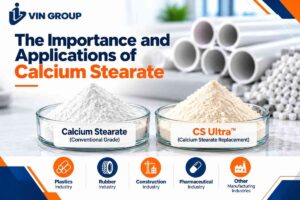
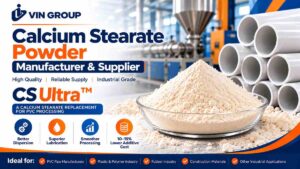
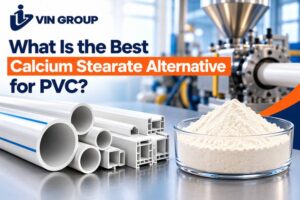
CS Ultra™ by VIN Group is a specially developed alternative designed as a 100% calcium stearate replacement in suitable PVC formulations.
It is intended to support PVC manufacturers looking to evaluate better lubrication, improved dispersion, smoother surface finish, and cost efficiency in their production processes.
For PVC casing and capping manufacturers, CS Ultra™ can be evaluated as part of the lubricant system through controlled production trials.
Key Benefits of CS Ultra™
- Cost-Effective Alternative: Designed to offer a lower-cost alternative to conventional calcium stearate.
- Better Dispersion: Intended to support improved additive dispersion in suitable formulations.
- Better Lubrication: Designed to support smoother PVC processing.
- Smoother Surface Finish: Helps manufacturers evaluate improvements in finished-product surface quality.
- PVC Processing Focus: Specifically developed for PVC processing applications.
Manufacturers should verify formulation compatibility, dosage, extrusion performance, and finished-product quality through technical evaluation before adopting a replacement.
Conclusion
PVC casing and capping play an important role in modern electrical wiring management. Their manufacturing requires suitable raw materials, controlled extrusion, dimensional accuracy, mechanical strength, and consistent surface quality.
Choosing the right PVC processing additives can also help manufacturers optimize production performance and manage manufacturing costs.
CS Ultra™ by VIN Group offers a calcium stearate replacement solution for evaluation in suitable PVC formulations. Manufacturers can explore its potential benefits for lubrication, dispersion, surface finish, and cost optimization through controlled production trials.
Explore CS Ultra™: https://csultra.com/
Company: VIN Group
Email: marketing@vin.co.in
Phone: +91 7403 7403 00