Calcium Stearate vs Calcium Stearate Replacement
However, PVC manufacturers may evaluate a Calcium Stearate replacement when they want to explore alternative additive systems, optimize processing, manage formulation costs or achieve specific performance requirements.
The important question is not simply whether one material can replace another. The real question is:
How does the replacement perform under the same PVC formulation and processing conditions?
This article explains the difference between conventional Calcium Stearate and Calcium Stearate replacement solutions and the factors manufacturers should consider before making a change.
What Is Calcium Stearate?
Calcium Stearate is a metallic stearate commonly used in plastics and other industrial applications.
In PVC processing, Calcium Stearate can perform multiple functions. Depending on the formulation, it may act as:
- A lubricant
- A processing aid
- A dispersing aid
- A mold-release aid
- An acid-scavenging component in certain polymer systems
For rigid PVC, technical documentation describes Calcium Stearate as helping during blending and extrusion while also providing lubrication and mold-release properties.
Its exact performance depends on factors such as:
- PVC resin type
- Stabilizer system
- Lubricant package
- Processing temperature
- Extrusion equipment
- Dosage
- Mixing conditions
- Required surface finish
Therefore, Calcium Stearate should not be evaluated separately from the complete PVC formulation.
Why Is Calcium Stearate Used in PVC?
PVC requires a carefully balanced additive system to achieve consistent processing and finished-product quality.
Calcium Stearate can contribute to lubrication and processing behavior by helping control friction within the processing system. Commercial PVC additive systems also distinguish between internal and external lubrication, with different lubricants selected according to processing requirements.
For manufacturers, the practical objectives may include:
Better processing → controlled lubrication → improved melt behavior → consistent extrusion
However, the exact result depends on the overall formulation.
What Is a Calcium Stearate Replacement?
A Calcium Stearate replacement is an alternative additive or additive system developed to perform some or all of the functions that a manufacturer currently obtains from Calcium Stearate.
The purpose of a replacement is not necessarily to duplicate the chemical identity of Calcium Stearate.
Instead, the goal is to achieve the required processing and product performance through another formulation.
A replacement may be evaluated for:
- Lubrication
- Dispersion
- Processing stability
- Surface finish
- Fusion behavior
- Production consistency
- Formulation economics
This is why a replacement should be judged on performance in the actual PVC formulation, rather than price or chemical name alone.
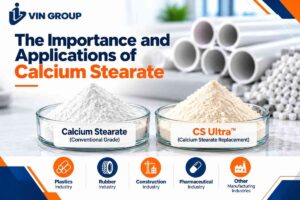
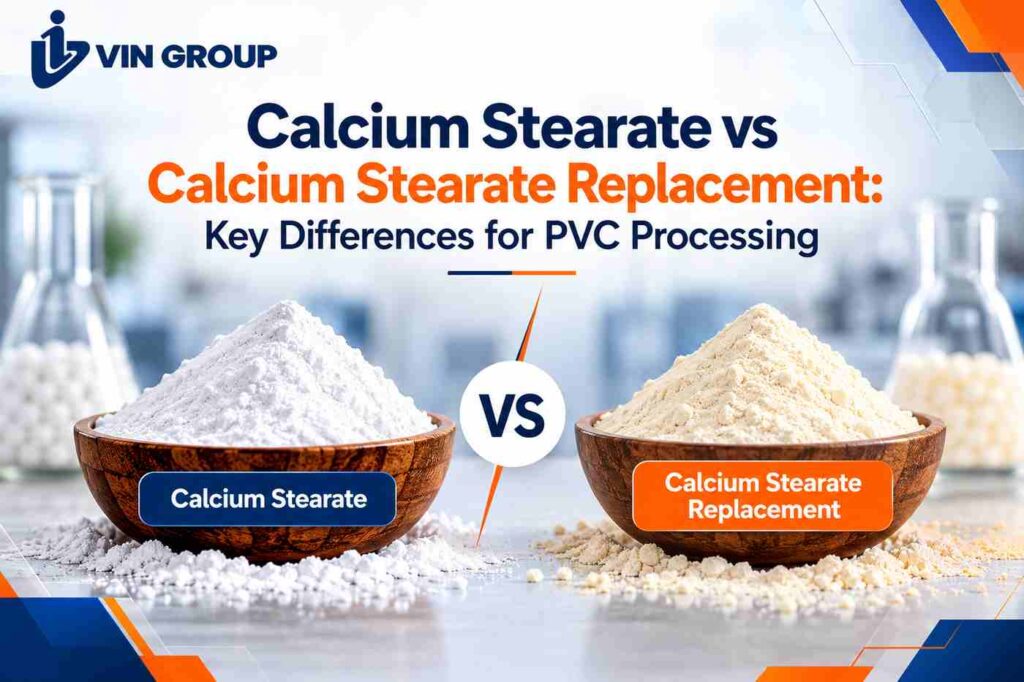
Calcium Stearate vs Calcium Stearate Replacement
| Factor | Calcium Stearate | Calcium Stearate Replacement |
|---|---|---|
| Material type | Conventional metallic stearate | Alternative additive/system |
| Lubrication | Yes, formulation dependent | Designed to provide required lubrication |
| Processing aid function | Commonly used in rigid PVC | Depends on replacement technology |
| Dispersion support | Can provide dispersion support | Depends on formulation |
| Formulation change | Existing formulation may already use it | May require optimization |
| Dosage | Application dependent | Must be established through trials |
| Surface finish | Depends on formulation | Should be evaluated under actual conditions |
| Cost | Depends on grade and supplier | Depends on product and formulation |
| Processing performance | Established in many applications | Requires application validation |
The key takeaway: there is no universal replacement formula that works identically in every PVC application.
Why Are PVC Manufacturers Considering Calcium Stearate Replacements?
There can be several reasons for evaluating an alternative.
1. Formulation Optimization
Manufacturers continuously optimize additive packages to achieve the desired balance between processing and finished-product quality.
2. Processing Performance
A different additive system may be evaluated when manufacturers want to improve specific processing characteristics.
3. Cost Optimization
Raw-material cost is an important part of PVC manufacturing economics. However, the lowest price per kilogram does not necessarily mean the lowest formulation cost.
Manufacturers should compare:
Cost per kg × dosage × production performance
rather than looking only at the purchase price.
4. Product Quality
Changes in lubrication and processing behavior can affect factors such as:
- Surface appearance
- Fusion
- Extrusion stability
- Dimensional consistency
- Production output
These parameters should be tested before adopting a replacement.
Can Calcium Stearate Be Directly Replaced?
Not necessarily.
A direct 1:1 replacement should not be assumed without testing.
The required dosage and performance can vary depending on the:
- PVC formulation
- Stabilizer package
- Lubricant system
- Processing temperature
- Extruder design
- Screw configuration
- Product specification
Even technical suppliers note that lubricant systems may need to be tailored to the formulation and application rather than assuming one ingredient can universally replace another.
Therefore, manufacturers should conduct controlled trials before changing production formulations.
How to Evaluate a Calcium Stearate Replacement
A proper evaluation should compare the existing Calcium Stearate formulation with the proposed replacement under controlled conditions.
Step 1: Establish the Current Baseline
Record the existing:
- Calcium Stearate dosage
- PVC resin
- Stabilizer system
- Other lubricants
- Processing temperature
- Extruder settings
- Production output
Step 2: Run a Controlled Trial
Test the replacement under comparable conditions.
Step 3: Compare Processing Performance
Measure relevant parameters such as:
- Fusion behavior
- Torque
- Pressure
- Melt behavior
- Extrusion stability
- Output
Step 4: Check Finished Product
Evaluate:
- Surface finish
- Color
- Dimensional stability
- Mechanical properties
- Product consistency
Step 5: Compare Economics
Calculate the actual formulation cost and production impact.
This approach provides a much better basis for deciding whether a Calcium Stearate replacement is suitable.
Calcium Stearate Replacement for PVC Pipes
PVC pipe manufacturing is one area where lubricant and processing-aid selection can be important.
Rigid PVC pipe formulations need to balance processing behavior with the required properties of the finished pipe.
A Calcium Stearate replacement can therefore be evaluated for applications such as:
- PVC pipes
- uPVC pipes
- PVC profiles
- Conduit pipes
- Fittings
- Other rigid PVC products
The replacement should be assessed according to the specific formulation and production conditions rather than assuming the same performance across all applications.
Calcium Stearate Replacement and Surface Finish
Surface finish is an important consideration in PVC extrusion.
An additive system that provides appropriate lubrication and processing behavior can contribute to smoother and more consistent extrusion.
However, surface quality is influenced by several factors, including:
- Lubricant balance
- Processing temperature
- Screw design
- Extrusion speed
- PVC formulation
- Stabilizer system
Therefore, a Calcium Stearate replacement should be evaluated as part of the complete processing system.
Calcium Stearate Replacement and Processing Cost
One of the most important mistakes manufacturers can make is comparing only the price per kilogram.
For example:
Product A: Lower price/kg but higher dosage
Product B: Higher price/kg but lower required dosage
In this situation, Product B may potentially provide a better formulation economics outcome.
The correct comparison should consider:
Material cost + dosage + output + quality + processing stability
This makes a production trial more valuable than a simple supplier price comparison.
CS Ultra™ as a Calcium Stearate Replacement
CS ULTRA™ is positioned as a Calcium Stearate replacement for suitable PVC processing applications.
It can be evaluated as an alternative to conventional Calcium Stearate where manufacturers are looking to optimize:
- Lubrication
- Dispersion
- Processing
- Surface finish
- Formulation economics
For applications such as PVC pipes and profiles, manufacturers should evaluate CS ULTRA™ under their actual formulation and production conditions.
Why Evaluate CS Ultra™?
- Calcium Stearate replacement
- Designed for PVC processing applications
- Supports lubrication and dispersion
- Suitable for evaluation in rigid PVC applications
- Potential formulation cost optimization
Performance should always be validated according to the specific formulation and processing conditions.
What Should You Check Before Switching?
Before replacing Calcium Stearate, PVC manufacturers should ask:
1. Does the replacement provide the required lubrication?
2. Does it maintain the required processing stability?
3. Does the surface finish remain consistent?
4. Does the replacement work with the existing stabilizer system?
5. Is the dosage suitable for the formulation?
6. Does it affect extrusion output?
7. What is the actual cost per finished product?
These questions provide a more useful evaluation than simply comparing two product prices.
Calcium Stearate vs Replacement: Which Is Better?
There is no universal answer.
Calcium Stearate remains an established material used in PVC and other polymer applications, with recognized lubrication and processing functions.
A Calcium Stearate replacement may be worth evaluating when a manufacturer wants to optimize processing, formulation economics or specific product-performance requirements.
The better option is ultimately the one that delivers the required processing performance, product quality and overall manufacturing economics in the manufacturer’s actual formulation.
Frequently Asked Questions
Is Calcium Stearate used in PVC?
Yes. Calcium Stearate is used in PVC formulations for functions including lubrication, processing assistance and dispersion support, depending on the formulation.
What is a Calcium Stearate replacement?
It is an alternative additive or additive system designed to provide some or all of the required functions of Calcium Stearate in a particular application.
Can Calcium Stearate be replaced 1:1?
Not necessarily. Dosage and performance should be established through formulation and processing trials.
Is Calcium Stearate replacement suitable for PVC pipes?
It can be evaluated for suitable rigid PVC pipe formulations, but performance depends on the formulation and processing conditions.
What should be compared when choosing a replacement?
Compare lubrication, processing stability, dispersion, surface finish, dosage, production output and total formulation economics.
Is a cheaper Calcium Stearate replacement always better?
No. The correct comparison should consider total formulation cost and production performance, not only price per kilogram.
Conclusion
Calcium Stearate has an established role in PVC processing, particularly as a lubricant and processing aid in rigid PVC applications.
However, manufacturers looking to optimize their formulations can evaluate Calcium Stearate replacement solutions based on actual processing requirements.
The most reliable approach is to compare both materials under controlled production conditions and measure processing behavior, surface quality, consistency, output and total formulation cost.
CS Ultra™ can be evaluated as a Calcium Stearate replacement for suitable PVC processing applications.