Why Choose CS Ultra™ for PVC Processing?
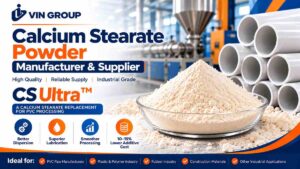
CS Ultra™ is a product of VIN Group, positioned as a 100% calcium stearate replacement for PVC processing applications. It offers PVC manufacturers an alternative to conventional calcium stearate for their formulation requirements.
Explore CS Ultra™ to learn more about this innovative solution for the PVC industry.
What Are the Uses of Calcium Stearate in PVC?
Looking for an effective calcium stearate replacement for PVC processing? CS Ultra™ is a product of VIN Group, is positioned as a 100% calcium stearate replacement for PVC applications, offering manufacturers an alternative to evaluate for their processing requirements.
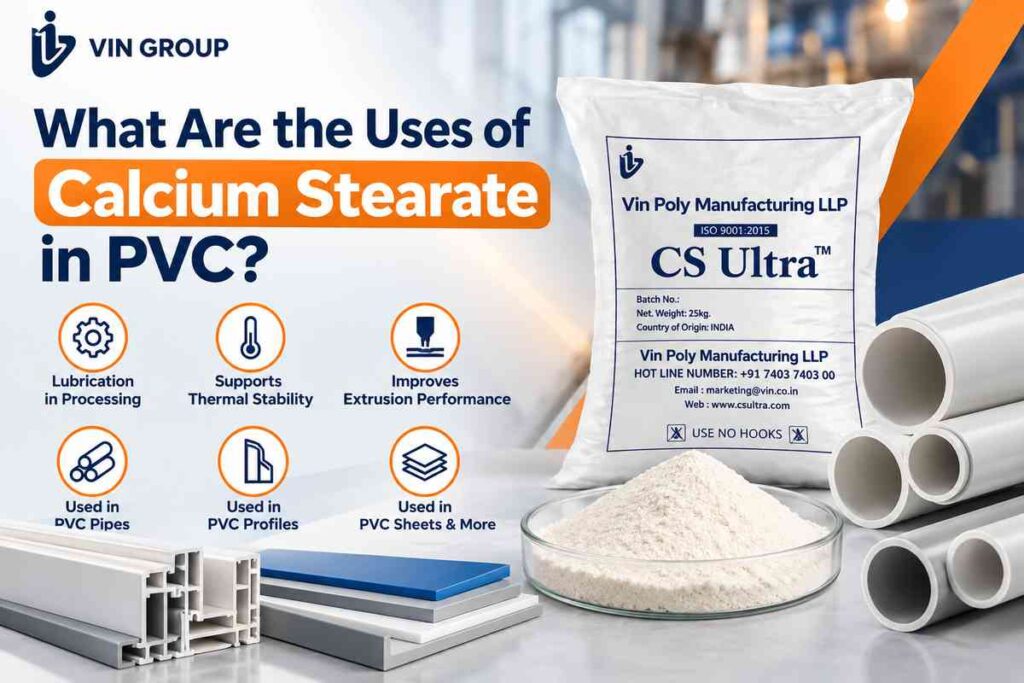
Calcium stearate is widely used in PVC manufacturing for lubrication, processing efficiency, and supporting thermal stabilization systems. It plays an important role in the production of PVC pipes, fittings, profiles, sheets, and other plastic products.
Understanding its applications, benefits, and limitations helps manufacturers make informed decisions about additive selection and formulation performance. In this blog, we explore the major uses of calcium stearate in PVC, its role in different manufacturing applications, and factors to consider when evaluating alternatives such as CS Ultra™.
What Is Calcium Stearate?
Calcium stearate is a calcium salt of stearic acid, generally available as a fine white powder. It is widely used in plastics, rubber, coatings, and other industrial applications because of its lubricating and water-repellent properties.
In PVC processing, calcium stearate primarily functions as a lubricant and processing aid. Depending on the formulation, it can also contribute to thermal stabilization and help improve the release of processed material from metal surfaces.
Its effectiveness depends on factors such as dosage, processing temperature, PVC formulation, and compatibility with other additives.
Key Uses of Calcium Stearate in PVC
1. Lubrication During PVC Processing
One of the primary uses of calcium stearate is lubrication. During extrusion, calendaring, and other PVC processing operations, friction can develop between the polymer compound and processing equipment.
Calcium stearate helps reduce friction and supports smoother material flow. When properly balanced with other lubricants, it can help manufacturers maintain consistent processing conditions and minimize unwanted material buildup.
2. Supporting Thermal Stability
PVC is sensitive to heat during processing. Excessive heat exposure can cause degradation, discoloration, and the release of hydrogen chloride.
Calcium stearate can contribute to a PVC thermal stabilization system by helping neutralize acidic degradation products. However, it is not a complete heat stabilizer on its own, and its performance depends on the overall stabilizer package and processing conditions.
3. Improving PVC Extrusion Performance
PVC extrusion is widely used to manufacture pipes, profiles, cable insulation, and other continuous products.
Calcium stearate helps regulate lubrication within the PVC compound, supporting smoother extrusion and more consistent production. The correct balance between internal and external lubrication is important because excessive lubrication may affect fusion, surface quality, and production output.
4. Reducing Equipment Sticking
During PVC processing, material may adhere to metal surfaces, dies, or other equipment components. This can contribute to deposits, surface defects, and interruptions in production.
Calcium stearate can help improve release characteristics and reduce sticking in suitable formulations. The actual results depend on equipment design, processing conditions, and the other lubricants used.
5. Supporting Surface Finish and Product Quality
A consistent surface finish is important in PVC products such as pipes, window profiles, sheets, and decorative materials.
When correctly formulated, calcium stearate can support stable processing and help reduce certain surface defects associated with inadequate lubrication. Final surface quality also depends on resin quality, additive compatibility, temperature control, and equipment design.
6. Applications in PVC Pipes and Fittings
PVC pipes and fittings are widely used in water distribution, drainage, irrigation, and construction.
Calcium stearate may be incorporated into rigid PVC formulations to support lubrication, processing stability, and production consistency. Manufacturers should select the additive package according to the intended application and applicable product standards.
7. Applications in PVC Profiles and Sheets
Rigid PVC profiles, window frames, wall panels, and sheets require controlled processing and reliable surface quality.
Calcium stearate can help manage friction and improve release during extrusion or calendaring. Its dosage should be optimized to maintain the required balance between processability, fusion, mechanical properties, and appearance.
8. Applications in PVC Cable Compounds
PVC is widely used as an insulating and sheathing material in electrical cables. Calcium stearate may be incorporated into selected cable-compound formulations to support processing and lubrication.
The final formulation must meet the electrical, mechanical, thermal, and safety requirements of the intended cable application.
Benefits of Using Calcium Stearate in PVC Manufacturing
When selected and used correctly, calcium stearate can offer several formulation benefits:
- Improved lubrication during processing.
- Better control of friction between the compound and equipment.
- Support for thermal stabilization systems.
- Improved release from processing surfaces.
- More consistent extrusion and production conditions.
- Potential reduction in processing-related surface defects.
These benefits depend on the formulation and processing conditions. Excessive or unsuitable additive levels can negatively affect PVC fusion, mechanical properties, or surface quality, making dosage optimization essential.
Factors to Consider When Selecting Calcium Stearate
Before adding calcium stearate to a PVC formulation, manufacturers should evaluate several important factors.
Purity and consistency: Consistent material quality helps support repeatable production results.
Particle size and dispersion: These properties can influence how effectively the additive distributes throughout the compound.
Dosage: The optimum concentration depends on the PVC grade, application, processing method, and other additives.
Compatibility: Calcium stearate should be evaluated alongside lubricants, stabilizers, fillers, and other formulation components.
End-use requirements: Pipes, profiles, cables, sheets, and other products may require different additive balances.
Laboratory testing and production trials are recommended before making changes to an established formulation.
Is Calcium Stearate Always the Best Choice for PVC?
Although calcium stearate is widely used, it may not be the ideal solution for every PVC formulation. Manufacturers sometimes explore alternative additives when they want to optimize processing efficiency, simplify additive combinations, or achieve specific performance targets.
Any alternative should be evaluated based on processing behaviour, thermal stability, product quality, compatibility, cost, and compliance with the requirements of the final application.
Comparing conventional calcium stearate with application-specific replacement solutions can help manufacturers identify an option that suits their production needs.
Explore CS Ultra™ by VIN Group
Looking for a calcium stearate replacement for PVC processing?
VIN Group offers CS Ultra™, positioned as a 100% calcium stearate replacement for PVC applications. It provides manufacturers with an alternative to evaluate when reviewing their existing formulations and processing requirements.
Before changing an established formulation, manufacturers should review the product’s technical documentation, recommended dosage, compatibility, and trial results with the supplier.
Discover more about CS ULTRA™ and explore its potential for your manufacturing requirements.
Visit the official website: https://csultra.com/
Conclusion
Calcium stearate serves several important functions in PVC manufacturing, including lubrication, supporting thermal stabilization systems, improving release characteristics, and helping maintain consistent processing conditions. It is used in formulations for pipes, fittings, profiles, sheets, and selected cable applications.
Its effectiveness depends on the formulation, processing method, dosage, and end-use requirements. By understanding these factors and evaluating suitable alternatives where necessary, PVC manufacturers can make more informed decisions about additive selection and production performance.
CS Ultra™ is a product of VIN Group, positioned as a 100% calcium stearate replacement for PVC processing applications. Visit csultra.com to learn more about the product and discuss your specific application requirements with our team.