Calcium Stearate Latest Price in India : Uses & PVC Applications
The Calcium Stearate price in India can vary significantly depending on the grade, purity, quantity, specification, supplier, packaging and delivery location.
For PVC manufacturers, however, the purchase price per kilogram is only one part of the decision.
A Calcium Stearate material that costs less per kilogram may not necessarily provide the lowest overall formulation cost if its dosage, specification or processing performance differs.
That is why buyers should look beyond the quoted ₹/kg price and compare the material according to its application and total manufacturing economics.
This guide explains current indicative pricing, the factors that influence Calcium Stearate cost, its major uses and its role in PVC processing.
What Is Calcium Stearate?
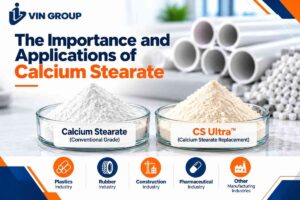
Calcium Stearate is a calcium salt of stearic acid and is commonly supplied as a fine powder.
It is used in a range of industrial applications because of its lubricating, release and processing-related properties.
In plastics, its role can include:
- Lubrication
- Processing assistance
- Release properties
- Dispersion support
- Stabilization-related functions in certain formulations
For PVC manufacturers, Calcium Stearate is particularly relevant as part of the lubricant and processing system used in rigid PVC formulations.
What Is the Current Calcium Stearate Price in India?
There is no single fixed Calcium Stearate price in India. According to IndiaMART listings available as of 7 October 2026, higher-grade and performance-oriented Calcium Stearate products are generally listed at around ₹110/kg to ₹140/kg, depending on the supplier, grade, quality, performance specifications, MOQ and product requirements.
The actual price may vary based on product specification, order quantity, packaging, GST and delivery location. For PVC manufacturers, it is therefore important to compare the price along with product quality and processing performance before selecting a Calcium Stearate grade.
Important
These figures should be treated as indicative online market references, not as one universal market rate.
A supplier quotation can change according to:
- Grade
- Purity
- Particle size
- MOQ
- Packaging
- GST
- Freight
- Delivery location
- Payment terms
- Order quantity
Therefore, buyers should request a current quotation for the exact specification they require.
Calcium Stearate Price Per Kg: Why Does It Change?
Searching for “Calcium Stearate price per kg” is useful for an initial comparison, but the quoted price alone does not determine whether one Calcium Stearate product is more cost-effective for PVC processing.
The actual cost can depend on the grade, quality, dosage, processing performance, MOQ and delivered cost.
For PVC manufacturers, it is therefore better to compare price per kg together with technical performance and actual formulation requirements, rather than choosing a product based only on the lowest quotation.
A better calculation is:
Effective Additive Cost
Price per kg × Actual Dosage
For a manufacturing decision, you can go further:
Material Cost + Processing Impact + Quality Impact + Production Impact
This is a much better way to evaluate an additive than comparing only the supplier quotation.
7 Factors That Affect Calcium Stearate Price in India
1. Grade
Industrial, technical, pharmaceutical and other grades can have different specifications and pricing.
A buyer should select the grade according to the actual application rather than simply choosing the cheapest available material.
2. Purity
Purity and other technical parameters can influence the commercial value of Calcium Stearate.
For example, current supplier listings show products with different purity levels, including 98% and 99% specifications.
Always compare equivalent specifications.
3. Particle Size
Particle size can matter in processing and dispersion.
Some suppliers list fine Calcium Stearate powders with particle sizes such as 1–10 µm.
A smaller or more controlled particle size may come with a different price depending on manufacturing and specification requirements.
4. Order Quantity
MOQ has a major effect on quoted price.
A 1 kg laboratory purchase cannot be directly compared with a 500 kg or 1,000 kg industrial order.
Current listings show MOQs ranging from small quantities to hundreds or thousands of kilograms.
5. Packaging
A 25 kg industrial bag, smaller trial pack and specialty packaging can have different effective costs.
For manufacturers, compare the cost per delivered kilogram, not simply the product price.
6. Freight and Location
A supplier offering a lower ex-works price may become more expensive after transportation.
For example:
Product Price + GST + Freight = Delivered Cost
This is the number that should be compared between suppliers.
7. Specification and Application
Calcium Stearate intended for a particular application may have specifications that differ from another grade.
Therefore:
Same product name ≠ necessarily same product specification.
Calcium Stearate Uses
Calcium Stearate is used across several industries.
Common applications include:
- Plastics
- PVC processing
- Rubber
- Paints and coatings
- Paper-related applications
- Release applications
- Lubrication systems
- Certain pharmaceutical and specialty applications
Its exact function depends on the grade and formulation.
Why Is Calcium Stearate Used in PVC?
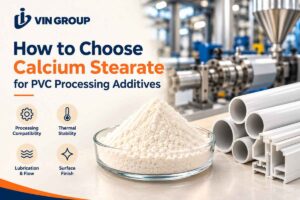
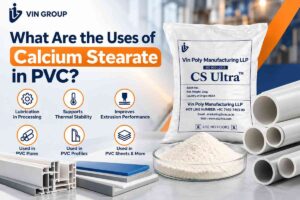
In PVC processing, Calcium Stearate can form part of the lubricant system.
It can contribute to processing characteristics such as:
Lubrication
Helps manage friction within the processing system.
Processing Behavior
Can influence the behavior of PVC during extrusion and melt processing.
Fusion
The lubricant balance can affect the way PVC develops during processing.
Surface Finish
Processing stability and lubricant balance can contribute to consistent surface appearance.
However, Calcium Stearate does not work independently.
Its behavior is influenced by:
- PVC resin
- Stabilizers
- Other lubricants
- Processing aids
- Temperature
- Extruder design
- Screw speed
Calcium Stearate for PVC Pipes
PVC pipe manufacturing requires controlled extrusion and consistent product quality.
Calcium Stearate may be used as part of the additive package for rigid PVC products such as:
- PVC pipes
- uPVC pipes
- PVC profiles
- Conduits
- Fittings
During production, manufacturers may monitor:
- Fusion
- Torque
- Extrusion pressure
- Surface finish
- Output
- Dimensional consistency
The appropriate formulation depends on the specific product and processing conditions.
Is There a Fixed Calcium Stearate Dosage for PVC?
No.
A universal dosage should not be applied to every PVC formulation.
The required level can vary with:
- Resin characteristics
- Stabilizer system
- Lubricant package
- Processing temperature
- Extruder configuration
- Product type
- Production speed
A controlled formulation trial is therefore a better way to establish the appropriate level.
Calcium Stearate Price vs Actual PVC Formulation Cost
The price per kilogram of Calcium Stearate does not always represent its actual cost in a PVC formulation. The final cost depends on the dosage used, formulation requirements and processing conditions.
For example, a small difference in the purchase price may have a limited impact on the overall formulation cost if the material is used at a relatively low dosage. On the other hand, changes in dosage can significantly affect the additive cost per kilogram of PVC compound.
Therefore, PVC manufacturers should evaluate the actual cost using:
Calcium Stearate Price × Actual Formulation Dosage
The final evaluation should also consider processing performance, product quality and overall production economics rather than focusing only on the purchase price per kilogram.
What Should You Ask a Calcium Stearate Supplier?
Before purchasing, ask for the following information:
Technical
- Product grade
- Purity
- Particle size
- Calcium content, where relevant
- Moisture
- Melting/softening characteristics
- Technical Data Sheet
- Certificate of Analysis
Commercial
- Price per kg
- MOQ
- Packaging
- GST
- Freight
- Delivery time
- Payment terms
Application
- Recommended application
- PVC suitability
- Sample availability
- Technical support
This prevents the common mistake of choosing a product solely because it has the lowest quoted price.
Calcium Stearate vs Calcium Stearate Replacement
PVC manufacturers may also compare conventional Calcium Stearate with alternative additive systems.
The reason may be:
- Processing optimization
- Lubrication requirements
- Dispersion
- Surface finish
- Formulation economics
- Supply flexibility
The correct comparison should focus on actual production performance and total formulation cost, rather than only the purchase price.
What Is a Calcium Stearate Replacement?
A Calcium Stearate replacement is an alternative additive or additive system designed to provide the required function in a specific application.
It does not necessarily need to duplicate the chemistry of Calcium Stearate.
The important question is:
Can the alternative provide the required processing performance at an acceptable total cost?
This should be established through application testing.
CS Ultra™ as a Calcium Stearate Replacement
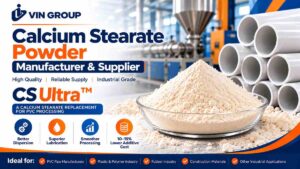
CS Ultra™ is positioned as a Calcium Stearate replacement for suitable PVC processing applications.
It can be evaluated by PVC manufacturers looking at:
- Lubrication
- Dispersion
- Processing performance
- Surface finish
- Formulation economics
For suitable PVC pipes, profiles and other rigid PVC applications, the product should be evaluated under the actual formulation and production conditions.
Explore CS Ultra™™
Calcium Stearate Replacement for PVC Processing
🌐 www.csultra.com
📞 +91 7403 7403 00
Performance and cost benefits should be evaluated under the specific formulation and processing conditions.
How to Choose the Right Calcium Stearate for PVC
Instead of asking only:
“Which Calcium Stearate is cheapest?”
ask:
1. Is the grade suitable for my application?
2. Does the specification match my current material?
3. What is the delivered cost?
4. What dosage is required?
5. Does it provide consistent processing?
6. Does it maintain the required surface finish?
7. Is the supply consistent batch to batch?
This approach helps turn a simple purchasing decision into a proper technical and commercial evaluation.
Frequently Asked Questions
What is the price of Calcium Stearate per kg?
There is no single fixed rate. The price depends on specification, quantity, supplier, packaging, GST and freight.
Why does Calcium Stearate have different prices?
Grade, purity, particle size, MOQ, packaging, supplier, logistics and application requirements can all affect the price.
Is Calcium Stearate used in PVC?
Yes. It can be used as part of the lubricant and processing system in PVC formulations.
Is Calcium Stearate used for PVC pipes?
Yes, it may be used in rigid PVC pipe formulations depending on the formulation and processing requirements.
Is cheaper Calcium Stearate always better?
No. The lowest price per kilogram may not result in the lowest total formulation cost or best processing performance.
Can Calcium Stearate be replaced?
Yes. Suitable alternative additive systems can be evaluated through controlled formulation and production trials.
What should I check before buying Calcium Stearate?
Check grade, purity, particle size, technical specifications, MOQ, packaging, GST, freight, delivered price and application suitability.
Conclusion
The Calcium Stearate price in India depends on much more than the number quoted per kilogram.
For PVC manufacturers, a meaningful comparison should include:
Price → Specification → Dosage → Processing → Product Quality → Delivered Cost
Current online listings demonstrate why buyers should not treat one published price as a universal market rate. Different products can have different grades, specifications, MOQs and commercial terms.
Calcium Stearate remains an established additive used in PVC processing, but manufacturers can also evaluate Calcium Stearate replacement solutions when looking for alternative processing or formulation approaches.
The best purchasing decision is therefore not necessarily the lowest price per kg.
It is the material that provides the required technical performance and overall manufacturing economics.