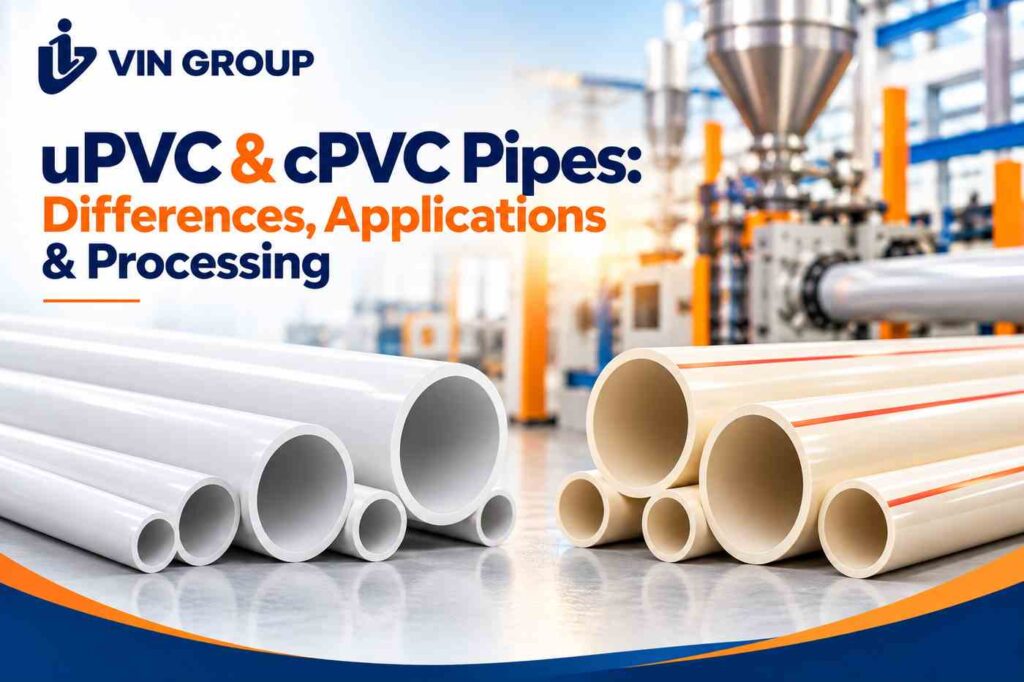
uPVC & cPVC Pipes: Differences, Applications and Processing
uPVC and cPVC pipes are widely used PVC-based piping solutions for residential, commercial, agricultural and industrial applications. Although both materials are derived from PVC, their composition, temperature capability, applications and processing requirements are different.
Understanding the difference between uPVC and cPVC pipes is important when selecting a piping material for water supply, drainage, plumbing or industrial applications.
This guide explains uPVC vs cPVC, their applications, manufacturing and processing, and the role of additives in PVC pipe production.
What Is uPVC?
uPVC stands for Unplasticized Polyvinyl Chloride.
It is a rigid form of PVC manufactured without plasticizers. Because of its rigidity, chemical resistance and suitability for extrusion, uPVC is widely used for pipes, fittings, profiles and electrical conduits.
Common uPVC Pipe Applications
uPVC pipes are commonly used for:
- Cold-water supply
- Drainage systems
- Sewerage
- Irrigation
- Agricultural water systems
- Electrical conduits
- Building plumbing
- Industrial applications
The suitability of a uPVC pipe depends on its specific grade, dimensions, pressure rating and applicable product standard.
What Is cPVC?
cPVC stands for Chlorinated Polyvinyl Chloride.
cPVC is produced by chlorinating PVC resin. This additional chlorination changes the properties of the material and gives cPVC better suitability for higher-temperature applications compared with conventional PVC systems.
Common cPVC Pipe Applications
cPVC pipes are commonly considered for:
- Hot-water plumbing
- Cold-water plumbing
- Residential water distribution
- Commercial plumbing
- Industrial fluid handling
- Chemical applications
- Suitable fire-protection systems
The actual suitability depends on the pipe grade, operating temperature, pressure and relevant standards.
uPVC vs cPVC: What Is the Difference?
The main difference between uPVC and cPVC is the way the PVC material is modified.
uPVC is unplasticized PVC, while cPVC is chlorinated PVC. This difference affects their temperature capability and typical applications.
| Feature | uPVC | cPVC |
|---|---|---|
| Full Form | Unplasticized Polyvinyl Chloride | Chlorinated Polyvinyl Chloride |
| Material | Rigid PVC | Chlorinated PVC |
| Temperature Capability | Generally suited to lower-temperature applications | Better suited to higher-temperature applications |
| Common Applications | Cold water, drainage, irrigation | Hot and cold water |
| Rigidity | High | High |
| Processing | PVC extrusion | Specialized PVC extrusion |
| Typical Use | Pipes, fittings, conduits | Hot-water and plumbing systems |
Important: The exact performance of a pipe should always be checked against the manufacturer’s specification and applicable standard.
uPVC Pipe Applications
uPVC pipes are used across several sectors because of their rigid structure and suitability for different piping systems.
1. Water Supply
uPVC pipes can be used for cold-water distribution where the pipe meets the required pressure and application specifications.
2. Drainage and Sewerage
Their rigid construction makes uPVC suitable for many drainage and sewerage applications.
3. Irrigation
uPVC pipes are used in agricultural and irrigation systems for water transportation.
4. Electrical Conduits
uPVC is also used to manufacture protective conduit systems for electrical cables.
5. Industrial Piping
Depending on the grade and chemical compatibility, uPVC can be used in selected industrial fluid-handling applications.
cPVC Pipe Applications
cPVC is particularly useful where the piping system needs to handle higher temperatures.
Hot-Water Plumbing
One of the major applications of cPVC is hot-water distribution.
Residential Plumbing
cPVC piping can be used for suitable hot- and cold-water plumbing systems.
Commercial Buildings
Hotels, hospitals, offices and commercial buildings may use cPVC systems where their technical specifications meet the project requirements.
Industrial Applications
Specific cPVC grades can be considered for industrial fluid handling where temperature and chemical compatibility requirements are satisfied.
uPVC Pipe Manufacturing Process
The uPVC pipe manufacturing process generally involves extrusion.
A simplified process is:
PVC Resin → Additive Mixing → Dry Blending → Extrusion → Die Formation → Sizing → Cooling → Cutting → Quality Inspection
1. Raw Material Preparation
PVC resin is combined with stabilizers, lubricants, processing aids, fillers, pigments and other required additives.
2. Dry Blending
The ingredients are mixed to achieve a consistent formulation before extrusion.
3. Extrusion
The dry blend enters an extruder where heat and mechanical shear transform the material into a processable melt.
4. Die Formation
The molten PVC passes through a pipe die to create the required tubular shape.
5. Sizing and Cooling
The hot pipe is calibrated and cooled to establish the required dimensions.
6. Cutting
The continuous pipe is cut into specified lengths.
7. Quality Testing
The finished product is checked according to the required dimensions, appearance and application-specific specifications.
cPVC Pipe Processing
The cPVC pipe processing approach is similar in broad terms to PVC extrusion, but formulation and processing conditions need to be controlled according to the specific cPVC resin and compound.
Important factors include:
- Resin characteristics
- Stabilizer system
- Lubricant balance
- Processing temperature
- Screw design
- Screw speed
- Residence time
- Shear conditions
- Extrusion equipment
A processing condition suitable for one PVC formulation should not automatically be applied to another formulation.
Role of Additives in PVC Pipe Processing
The performance of uPVC and cPVC pipes depends on more than the base polymer.
A PVC pipe formulation may contain several additives, including:
- Heat stabilizers
- Lubricants
- Processing aids
- Impact modifiers
- Fillers
- Pigments
- Other application-specific additives
The balance between these components can influence processing behaviour and finished-product quality.
Calcium Stearate in PVC Pipe Processing
Calcium Stearate is commonly considered as part of the lubricant system used in PVC processing.
During extrusion, the PVC compound experiences heat, shear, pressure and friction. The lubricant system can influence material flow, fusion behaviour, processing stability and surface characteristics.
Calcium Stearate can therefore be evaluated in PVC pipe formulations as part of the overall processing system.
However, there is no single Calcium Stearate dosage that applies to every PVC pipe formulation.
Performance can depend on:
- PVC resin
- Stabilizer system
- Other lubricants
- Fillers
- Pigments
- Extruder design
- Processing temperature
- Production speed
Calcium Stearate Replacement for PVC Pipes
PVC manufacturers may also evaluate a Calcium Stearate replacement when looking for an alternative processing additive.
A replacement should not be selected only on the basis of price. It should be evaluated for its performance within the complete PVC formulation.
Important parameters include:
Lubrication → Fusion → Dispersion → Torque → Pressure → Surface Finish → Output → Product Quality
This is particularly important for continuous PVC pipe extrusion, where even small changes in formulation can affect processing behaviour.
CS Ultra™ – Calcium Stearate Replacement for PVC
CS Ultra™ is positioned as a Calcium Stearate replacement for suitable PVC processing applications.
It can be evaluated against an existing Calcium Stearate formulation based on the manufacturer’s specific requirements.
The evaluation can include:
- Lubrication performance
- Dispersion
- Fusion behaviour
- Processing stability
- Surface finish
- Production output
- Overall additive economics
Actual performance should be validated under the specific formulation and processing conditions.
Explore CS Ultra™:
🌐 www.csultra.com
📞 +91 7403 7403 00
uPVC vs cPVC: Which One Should You Choose?
The answer depends on the application.
uPVC may be suitable when:
- Cold-water service is required
- Drainage is required
- Irrigation is required
- Electrical conduit applications are involved
- The application does not require high-temperature service
cPVC may be considered when:
- Hot-water service is required
- Higher operating temperatures are involved
- The selected pipe has the required temperature and pressure rating
- The application meets the product’s technical specifications
The manufacturer’s technical documentation should always be checked before selecting a piping system.
Key Factors for PVC Pipe Manufacturers
Manufacturers should consider several factors when producing uPVC or cPVC pipes.
Formulation
The correct balance of resin, stabilizers, lubricants, fillers and processing aids is important.
Processing Conditions
Temperature, screw speed, pressure and residence time should be controlled.
Equipment
Extruder type, screw design, die configuration and calibration equipment can affect processing.
Surface Finish
The finished pipe should be checked for consistent surface appearance.
Dimensional Accuracy
Pipe diameter, wall thickness and other dimensions should meet the required specification.
Product Performance
Finished pipes should be tested according to the relevant application and product standards.
Frequently Asked Questions
What is the difference between uPVC and cPVC?
uPVC is unplasticized PVC, while cPVC is chlorinated PVC. cPVC generally has better suitability for higher-temperature applications.
Is uPVC better than cPVC?
Neither material is universally better. The correct choice depends on temperature, pressure, application and product specifications.
Is cPVC suitable for hot water?
cPVC is commonly used for hot-water applications because of its higher temperature capability compared with conventional PVC systems.
What are uPVC pipes used for?
uPVC pipes are commonly used for cold-water supply, drainage, sewerage, irrigation, conduits and selected industrial applications.
What are cPVC pipes used for?
cPVC pipes are commonly used for hot- and cold-water plumbing and selected industrial applications.
What is used in PVC pipe processing?
PVC pipe formulations can contain stabilizers, lubricants, processing aids, fillers, pigments and other additives depending on the product.
Is Calcium Stearate used in PVC pipes?
Yes. Calcium Stearate can be used as part of the lubricant system in suitable PVC formulations.
Can Calcium Stearate be replaced in PVC?
Yes, a suitable alternative can be evaluated through controlled formulation and production trials.
Conclusion
uPVC and cPVC pipes are both important PVC-based piping solutions, but their applications and temperature capabilities are different.
uPVC is widely used for cold-water, drainage, irrigation and conduit applications, while cPVC is commonly considered for applications involving higher temperatures, particularly hot-water plumbing.
For manufacturers, successful PVC pipe production depends on more than polymer selection. Resin, stabilizers, lubricants, processing aids, fillers, equipment and processing conditions all contribute to the final product.
Calcium Stearate can form part of the lubricant system in PVC processing, while a Calcium Stearate replacement for PVC such as CS Ultra™ can be evaluated where an alternative additive solution is being considered.