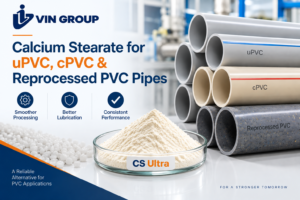
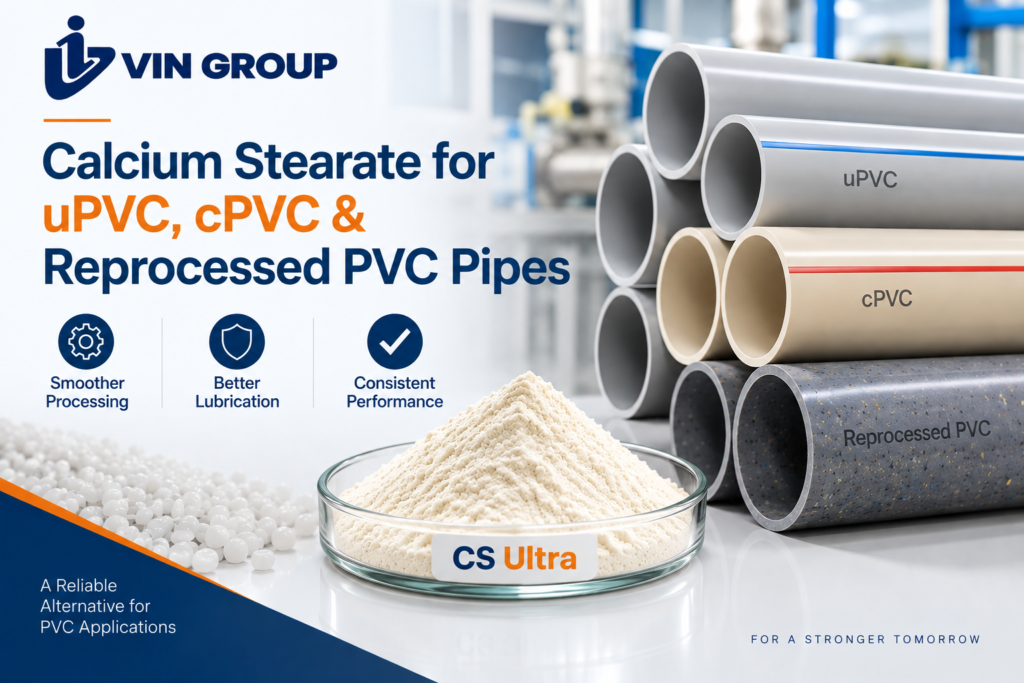
Calcium Stearate for uPVC, cPVC & Reprocessed PVC Pipes
Calcium Stearate for uPVC, cPVC and reprocessed PVC pipe applications is commonly used as a lubricant and processing aid during pipe manufacturing. It helps control friction during extrusion and supports smooth, stable and consistent processing of PVC compounds.
Calcium Stearate for uPVC Pipes
In uPVC pipe manufacturing, calcium stearate can contribute to the lubrication system of the formulation. It helps reduce friction between the PVC material and processing equipment, supporting stable extrusion and smoother processing.
Proper lubrication is particularly important for rigid PVC because processing conditions can affect surface quality, dimensional consistency and production efficiency. The optimum calcium stearate level depends on the formulation, equipment and processing conditions.
Calcium Stearate for cPVC Pipes
CPVC requires carefully controlled processing because it is processed at higher temperatures than conventional PVC. Calcium stearate may be used as part of the lubricant system to support processing performance and reduce unwanted friction.
Manufacturers should optimize the dosage through formulation and production trials to achieve the required processing and product properties.
Calcium Stearate for Reprocessed PVC Pipes
In reprocessed or recycled PVC pipe manufacturing, calcium stearate may be used as part of the lubricant system to support smoother processing of PVC material during extrusion.
Reprocessed PVC can have variations in material history, thermal exposure and formulation composition. Proper lubrication can help manage processing friction and support more consistent extrusion performance.
Depending on the quality and composition of the reprocessed PVC, calcium stearate can contribute to:
- Smoother extrusion of reprocessed PVC
- Better processing consistency
- Controlled friction during extrusion
- Improved surface finish
- More stable processing conditions
- Consistent production performance
The required dosage should be determined through formulation and production trials, particularly when working with different grades or sources of reprocessed PVC.
Key Benefits
Using calcium stearate in suitable uPVC, cPVC and reprocessed PVC pipe formulations can help provide:
- Better lubrication during extrusion
- Reduced processing friction
- Smoother processing
- Improved surface finish
- Consistent production performance
- Better control during pipe extrusion
- Support for processing reprocessed PVC materials
CS Ultra as a Calcium Stearate Alternative
For manufacturers looking for an alternative to conventional calcium stearate, CS Ultra can be evaluated for suitable uPVC, cPVC and reprocessed PVC applications as part of a controlled formulation trial.
Performance and dosage should be evaluated according to the specific PVC formulation, processing equipment and required pipe properties.
Conclusion
Selecting the appropriate lubricant system is important for efficient uPVC, cPVC and reprocessed PVC pipe manufacturing. Calcium stearate can play a useful role in supporting smooth extrusion, controlled processing and consistent production performance when properly formulated.
For reprocessed PVC applications, formulation conditions can vary depending on the source and quality of the material. Therefore, production trials are recommended to determine the appropriate lubricant level and processing conditions.