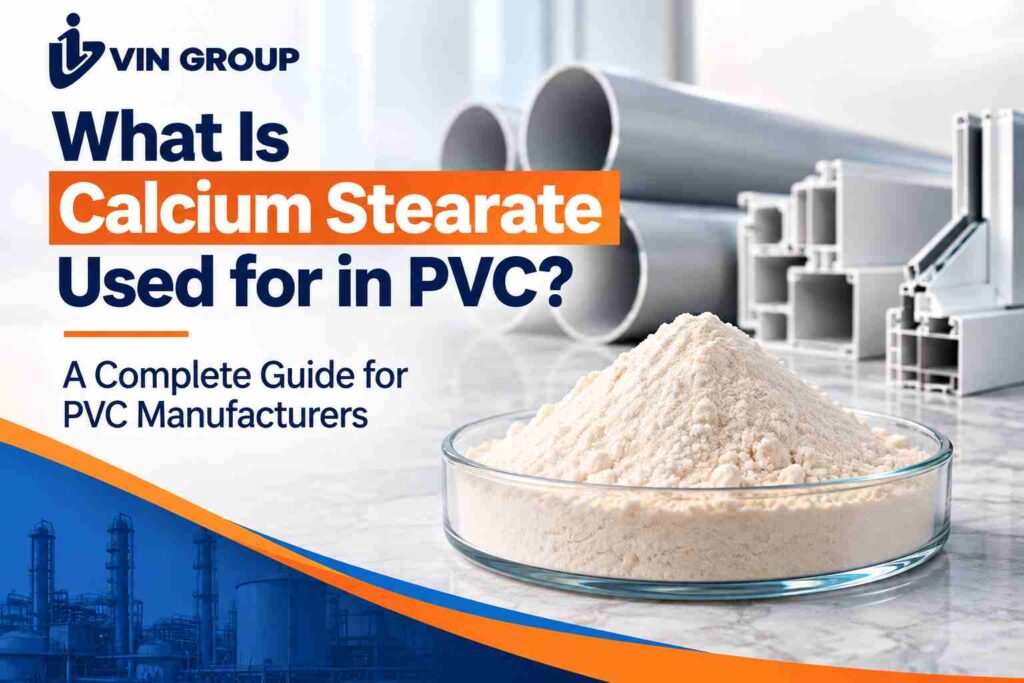
What Is Calcium Stearate Used for in PVC? A Complete Guide for PVC Manufacturers
Calcium Stearate is one of the commonly used additives in PVC formulations, particularly for its lubricating and processing properties. It can help control friction during PVC processing, support material flow and contribute to more consistent production when used as part of a properly balanced formulation.
It is used in a wide range of PVC products, including PVC pipes, UPVC pipes, conduit pipes, profiles, casing and capping, flooring, windows and doors.
For PVC manufacturers, understanding how Calcium Stearate works, where it is used and how it affects processing can help in developing an efficient formulation.
What Is Calcium Stearate?
Calcium Stearate is a calcium salt derived from stearic acid. It is generally supplied as a fine white powder and is widely used in plastics, rubber and other industrial applications.
In PVC processing, Calcium Stearate is primarily associated with lubrication and processing behaviour. It can influence the interaction between the PVC compound, processing equipment and other formulation components.
The performance of Calcium Stearate can vary according to several factors, including:
- PVC formulation
- Additive dosage
- Processing temperature
- Processing equipment
- Stabilizer system
- Other lubricants and additives
Therefore, the appropriate dosage should be established through formulation and production trials.
What Is Calcium Stearate Used for in PVC?
Calcium Stearate is mainly incorporated into PVC formulations to support processing and lubrication. Its exact function can vary depending on the type of PVC compound and manufacturing process.
1. Lubrication During PVC Processing
One of the main reasons manufacturers use Calcium Stearate in PVC is its lubricating action.
During extrusion, PVC compounds are subjected to heat, pressure and mechanical forces. Lubrication can help reduce friction between the material and processing surfaces, supporting smoother movement through the equipment.
This can be particularly important in continuous PVC extrusion processes.
2. Supporting Material Flow
PVC compounds need to move consistently through equipment such as extruders and dies.
When used at an appropriate level, Calcium Stearate can contribute to the processing behaviour of the compound and support smoother material flow.
However, its effect depends on the complete formulation rather than the additive alone.
3. Supporting Surface Quality
Lubrication and processing conditions can influence the appearance of an extruded PVC product.
A properly balanced formulation containing Calcium Stearate may help support a more consistent surface finish in products such as:
- PVC pipes
- Profiles
- Casing and capping
- Flooring
- Window and door profiles
The final surface quality is also influenced by formulation design, equipment settings, temperature and die conditions.
4. Maintaining Processing Consistency
For PVC manufacturers, consistent production is important for maintaining product quality and reducing processing variations.
Calcium Stearate can form part of a balanced lubrication system that supports repeatable processing behaviour.
The quality and consistency of the additive itself are also important, which is why manufacturers should evaluate both the material and its performance during production trials.
Where Is Calcium Stearate Used in PVC?
Calcium Stearate is used in different PVC formulations and products. Common applications include:
- PVC Pipes
- UPVC Pipes
- Conduit Pipes
- PVC Profiles
- Casing & Capping
- PVC Flooring
- PVC Windows & Doors
- Rigid PVC Products
- Selected Flexible PVC Applications
The required amount of Calcium Stearate is not the same for every application. Dosage should be determined according to the formulation, processing conditions and required product properties.
Why Is Lubrication Important in PVC Extrusion?
PVC extrusion involves the movement of a formulation through an extruder under controlled temperature, pressure and mechanical conditions.
Friction within the processing system can affect material movement and processing behaviour. This is why lubrication is an important part of many PVC formulations.
Calcium Stearate may be used as part of the lubrication system to help manage friction and support processing.
However, more additive does not necessarily mean better performance. An excessive or insufficient level can affect the balance of the formulation. Manufacturers should therefore determine the optimum level through controlled trials.
Factors That Affect Calcium Stearate Performance in PVC
The performance of Calcium Stearate cannot be evaluated by dosage alone. Several formulation and processing variables can influence the final result.
Important factors include:
PVC Resin Type
Different PVC resin systems can have different processing requirements.
Lubricant Combination
Calcium Stearate may be used alongside other internal or external lubricants. The interaction between these materials can influence processing behaviour.
Stabilizer System
Heat stabilizers and other additives can affect the overall behaviour of the PVC compound.
Processing Temperature
Temperature has a significant effect on PVC fusion and processing. The additive system needs to be compatible with the selected processing conditions.
Dosage
The optimum dosage depends on the application and formulation. A level suitable for one PVC product may not necessarily be suitable for another.
How Does Calcium Stearate Affect PVC Processing Cost?
For manufacturers, the cost of an additive should not be evaluated only by its price per kilogram.
A better approach is to consider the total additive cost within the formulation.
Manufacturers can compare:
- Cost per kg
- Recommended dosage
- Processing performance
- Lubrication behaviour
- Surface finish
- Production consistency
- Product quality
- Total formulation cost
For this reason, a material with a lower purchase price is not automatically the lowest-cost solution. The actual economics depend on how the additive performs in the complete formulation.
What Is the Price of Calcium Stearate?
The Calcium Stearate price can vary depending on factors such as supplier, grade, quantity, specifications, raw material costs and market conditions.
For industrial buyers, comparing only the quoted price per kg may not provide a complete picture.
A more useful comparison includes both the material price and the dosage required to achieve the desired processing performance.
For bulk procurement, manufacturers should also consider consistency between batches, technical specifications, supply reliability and application performance.
Is There a Calcium Stearate Replacement for PVC?
Yes. PVC manufacturers can evaluate alternative processing additives when they want to optimize formulation cost or processing performance.
CS ULTRA™ is developed as a 100% Calcium Stearate replacement for suitable PVC applications.
It is designed for use as a PVC processing additive with a focus on lubrication, dispersion and smoother processing.
CS ULTRA™ can be evaluated in applications such as:
- PVC pipes
- UPVC pipes
- PVC profiles
- Casing and capping
- PVC flooring
- Windows and doors
- Other suitable PVC formulations
The suitability of any replacement should be established through formulation and production trials because the optimum dosage can differ between applications.
CS ULTRA™ as a Calcium Stearate Replacement
For manufacturers considering alternatives to conventional Calcium Stearate, CS ULTRA™ provides an option for formulation evaluation.
Depending on the formulation, dosage, application, order quantity and prevailing market conditions, CS ULTRA™ may offer potential additive cost savings of around 10–15% compared with conventional Calcium Stearate.
This figure is indicative rather than guaranteed. Actual savings should be calculated using the customer’s formulation and production data.
Key Points About CS ULTRA™
- 100% Calcium Stearate replacement
- Designed for suitable PVC applications
- Supports lubrication
- Supports dispersion
- Designed for smoother processing
- Potential for lower additive cost
- Made in India
Calcium Stearate vs CS ULTRA™
| Parameter | Calcium Stearate | CS ULTRA™ |
|---|---|---|
| Primary Application | PVC lubrication and processing | PVC processing additive |
| Replacement | Conventional PVC additive | 100% Calcium Stearate replacement |
| Lubrication | Used for lubrication | Designed to support lubrication |
| Dispersion | Depends on formulation | Designed to support dispersion |
| Processing | Formulation dependent | Designed for smoother processing |
| Cost | Market dependent | Potential 10–15% lower additive cost* |
| Origin | Depends on supplier | Made in India |
Potential cost savings depend on formulation, dosage, application, purchase quantity and market conditions. Actual performance and economics should be validated through trials.
How to Choose the Right Calcium Stearate Alternative
Choosing a PVC additive should involve more than comparing product prices.
Before switching from Calcium Stearate to an alternative, manufacturers can evaluate:
- Compatibility with the existing PVC formulation
- Recommended dosage
- Lubrication performance
- Dispersion behaviour
- Extrusion performance
- Surface finish
- Production consistency
- Overall formulation cost
A controlled trial using the existing formulation can provide a more meaningful comparison than price-based evaluation alone.
Can Calcium Stearate Be Completely Replaced?
A complete replacement depends on the specific PVC formulation and application.
Although CS ULTRA™ is developed as a 100% Calcium Stearate replacement, manufacturers should conduct formulation trials before making a production-scale change.
Trial results can help determine the appropriate dosage and assess processing behaviour, product appearance and overall cost.
Frequently Asked Questions
What is Calcium Stearate used for in PVC?
Calcium Stearate is primarily used in PVC as a lubricant and processing aid. It can help manage friction and support smoother processing when used at an appropriate level.
Is Calcium Stearate a lubricant for PVC?
Yes. Calcium Stearate is commonly used as part of the lubrication system in PVC formulations.
Where is Calcium Stearate used?
It is used in various PVC applications, including pipes, profiles, conduit pipes, casing and capping, flooring and window and door profiles.
What is a Calcium Stearate replacement?
A Calcium Stearate replacement is an alternative additive designed to perform the required function of Calcium Stearate within a suitable PVC formulation. CS ULTRA™ is developed as a 100% Calcium Stearate replacement for suitable PVC applications.
How much Calcium Stearate is required in PVC?
There is no single dosage suitable for every PVC formulation. The required level depends on the resin, stabilizer system, lubricant package, processing conditions and product requirements.
Is CS ULTRA™ suitable for PVC pipes?
CS ULTRA™ can be evaluated for suitable PVC pipe formulations. The final dosage and performance should be confirmed through formulation and production trials.
How can PVC manufacturers reduce additive cost?
Manufacturers can evaluate additive cost based on price per kg, dosage, processing performance and total formulation cost rather than purchase price alone. Alternatives such as CS ULTRA™ may be evaluated where appropriate.
Conclusion
Calcium Stearate remains a widely used additive in PVC processing because of its role in lubrication and processing behaviour. It is used across applications such as PVC pipes, profiles, conduit pipes, casing and capping, flooring and windows and doors.
However, the performance and economics of any PVC additive depend on the complete formulation and processing conditions.
For manufacturers looking for an alternative, CS ULTRA™ is developed as a 100% Calcium Stearate replacement for suitable PVC applications. It is designed to support lubrication, dispersion and smoother processing, with potential additive cost savings depending on the formulation and application.
Before adopting any replacement, manufacturers should conduct appropriate formulation and production trials to confirm performance and actual cost benefits.