Rigid PVC Pipes: Manufacturing, Uses & Calcium Stearate
Rigid PVC pipes are widely used across plumbing, water distribution, drainage, irrigation, electrical installations and industrial applications because they combine durability, chemical resistance and relatively efficient processing.
Unlike flexible PVC products, rigid PVC pipes are designed to maintain their shape and mechanical performance without the addition of large amounts of plasticizers. Their final performance depends not only on PVC resin but also on the formulation, stabilizers, lubricants, fillers, pigments and processing conditions used during manufacturing.
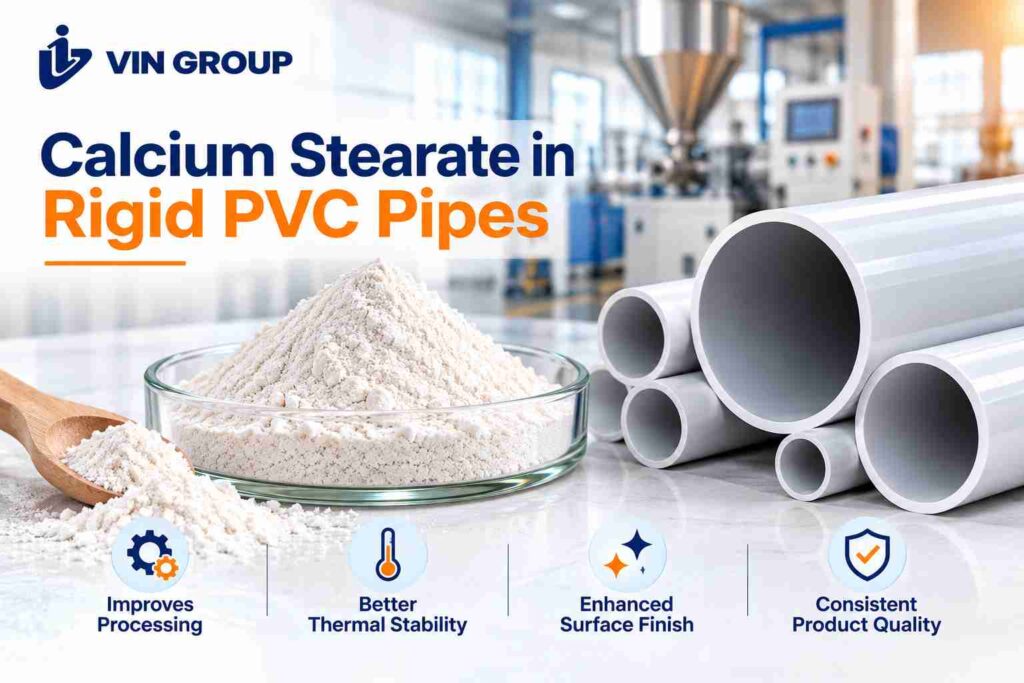
One important additive used in rigid PVC processing is calcium stearate. It can contribute to lubrication and thermal stabilization within a properly balanced PVC formulation, helping manufacturers achieve more consistent processing.
In this guide, we will explain what rigid PVC pipes are, how rigid PVC pipes are manufactured, where they are used, their key benefits, and the role of calcium stearate for PVC pipes.
What Are Rigid PVC Pipes?
Rigid PVC pipes are pipes manufactured from unplasticized polyvinyl chloride, commonly referred to as uPVC or PVC-U.
The term “rigid” refers to the relatively hard structure of the finished material. Unlike flexible PVC, rigid PVC is formulated to maintain dimensional stability and provide the mechanical properties required for applications such as water supply, drainage, conduit and industrial piping.
Rigid PVC pipes are generally manufactured through an extrusion process. PVC resin is combined with stabilizers, lubricants, fillers, pigments and other formulation ingredients before the compound is processed through an extruder and shaped through a die.
The exact formulation varies according to the pipe’s intended application, required standards, pressure rating, diameter, wall thickness and desired mechanical properties.
Why Are Rigid PVC Pipes Widely Used?
The popularity of rigid PVC pipes comes from a combination of material and processing advantages.
1. Good Chemical Resistance
Rigid PVC has good resistance to many commonly encountered chemicals, making it useful in drainage, industrial and wastewater applications.
2. Lightweight Construction
Compared with many traditional metal piping systems, PVC pipes are relatively lightweight. This can simplify handling, transportation and installation.
3. Corrosion Resistance
PVC does not rust like conventional steel or iron piping. This makes it useful in environments where corrosion resistance is an important consideration.
4. Smooth Internal Surface
A properly manufactured PVC pipe can provide a relatively smooth internal surface, which is useful for fluid-flow applications.
5. Dimensional Stability
Rigid PVC maintains its shape under normal application and processing conditions when the formulation and manufacturing process are properly controlled.
6. Versatile Applications
Rigid PVC pipes are available in different dimensions and specifications for applications ranging from plumbing and drainage to electrical conduit and industrial systems.
Rigid PVC Pipe Manufacturing Process
The manufacturing of rigid PVC pipes generally involves several controlled stages. While formulations and equipment can vary between manufacturers, the basic process commonly includes raw material preparation, dry blending, extrusion, sizing, cooling, cutting, inspection and packaging.
Step 1: Raw Material Selection
The first stage is selecting the appropriate raw materials for the required pipe specification.
A typical rigid PVC formulation may contain:
- PVC resin
- Heat stabilizer
- Lubricants
- Calcium carbonate or other fillers
- Pigments
- Processing aids
- Impact modifiers where required
- Other performance additives
The selection and balance of these ingredients can significantly affect processing behavior and final pipe performance.
Step 2: Dry Blending
The selected materials are accurately weighed and mixed in a high-speed mixer or other suitable blending equipment.
The objective is to achieve a homogeneous dry blend so that the different additives are distributed consistently throughout the PVC resin.
Good dispersion at this stage is important because poor mixing can contribute to inconsistent processing and variation in the finished product.
Step 3: PVC Extrusion
The prepared PVC compound is then fed into an extruder.
Inside the extruder, controlled heat and mechanical shear soften and homogenize the PVC compound. The material moves through the barrel and is eventually pushed through a specially designed pipe die.
The die determines the basic shape of the continuous pipe.
Extrusion is one of the most important stages of PVC pipe manufacturing because temperature, screw speed, material feed, pressure and lubrication must remain within an appropriate processing window.
Step 4: Sizing and Calibration
After leaving the die, the hot PVC pipe enters the sizing or calibration section.
Vacuum calibration is commonly used to establish the required external diameter and dimensional accuracy.
The pipe must be properly supported during this stage because the material is still hot and has not completely solidified.
Step 5: Cooling
The pipe passes through cooling tanks where controlled water cooling helps solidify the PVC structure.
Proper cooling contributes to dimensional stability and helps the pipe maintain the required diameter and shape.
Step 6: Cutting
After cooling, the continuous PVC pipe is cut into predetermined lengths.
Automated cutting systems can be synchronized with the extrusion line to maintain consistent pipe lengths.
Step 7: Inspection and Quality Control
Finished pipes are inspected according to the required product specification.
Depending on the application, manufacturers may evaluate parameters such as:
- Outer diameter
- Wall thickness
- Length
- Appearance
- Dimensional accuracy
- Impact resistance
- Pressure performance
- Chemical resistance
- Surface quality
Quality control is essential because even small variations in extrusion conditions can affect the consistency of the finished pipe.
Step 8: Packaging and Storage
After inspection, the pipes are bundled, labeled and prepared for transportation.
Proper handling and storage help prevent unnecessary damage before installation.
What Is the Role of Calcium Stearate in PVC Pipes?
Calcium stearate for PVC pipes is primarily used as part of the additive system in rigid PVC formulations.
Its importance comes from its ability to provide lubrication and contribute to stabilization behavior during PVC processing.
PVC requires thermal stabilization during processing because elevated temperatures can cause degradation. Calcium-based stabilizer systems are widely used in modern PVC applications, including different types of pipes and fittings.
Calcium stearate can also function as a lubricant. This makes it relevant to extrusion because lubrication influences friction, melt behavior, fusion and interaction between the PVC compound and processing equipment.
Calcium Stearate as a Lubricant
During PVC extrusion, the formulation experiences friction and shear inside the processing equipment.
Calcium stearate can contribute to the lubrication balance of the formulation.
Depending on the overall additive package and dosage, lubrication can influence:
- Melt flow
- Fusion behavior
- Processing stability
- Die release
- Surface finish
- Extrusion torque
However, calcium stearate should not simply be added at a higher level to obtain more lubrication. The correct level depends on the complete PVC formulation and processing conditions.
Excessive lubrication can disturb the desired fusion and processing balance and may contribute to issues such as plate-out or surface defects.
Calcium Stearate and Thermal Stabilization
Calcium stearate can also play a role in PVC stabilization systems by helping neutralize hydrogen chloride generated during PVC thermal degradation.
This is one reason calcium-based stabilization systems are important in PVC processing.
For rigid PVC pipe manufacturers, the stabilizer and lubricant system must be balanced to provide an appropriate processing window while maintaining the required properties of the finished product.
Why Is Calcium Stearate Important in Rigid PVC Pipe Manufacturing?
A rigid PVC pipe formulation needs more than PVC resin alone.
During extrusion, the material needs an additive system that supports thermal stability, lubrication, fusion and processing consistency.
Calcium stearate can contribute to this formulation in several ways.
Processing Lubrication
It can help manage friction within the PVC compound and support smoother processing.
Fusion Control
Lubricant balance affects how PVC particles fuse during extrusion. The correct formulation helps manufacturers achieve consistent melt behavior.
Thermal Stability Support
Calcium stearate can act as part of the stabilization system and help manage the effects of thermal degradation.
Surface Quality
A properly balanced lubricant system can contribute to consistent extrusion and surface quality.
Processing Consistency
Consistent additive dispersion and controlled formulation can help maintain stable extrusion conditions.
It is important to remember that calcium stearate is one component of a complete PVC formulation. Final performance depends on the interaction between resin, stabilizers, lubricants, fillers, processing aids, pigments and machine conditions.
Applications of Rigid PVC Pipes
Rigid PVC pipes are used across multiple industries because of their combination of rigidity, chemical resistance, lightweight construction and processability.
1. Water Supply
PVC pressure pipes can be used in suitable water distribution systems where the pipe specification meets the application requirements.
2. Drainage Systems
Rigid PVC pipes are commonly used for drainage and wastewater applications.
3. Sewerage
PVC pipe systems can be used for underground sewerage and wastewater networks depending on the required specification.
4. Irrigation
Rigid PVC pipes are used in agricultural and irrigation systems for transporting water.
5. Electrical Conduits
PVC conduit pipes are widely used for protecting electrical cables and wiring.
6. Industrial Piping
Certain rigid PVC pipe grades are used for transporting fluids in industrial environments where their chemical resistance and operating requirements are suitable.
7. Plumbing
PVC and uPVC pipes are widely used in plumbing installations for different water and drainage requirements.
Key Benefits of Rigid PVC Pipes
Rigid PVC pipes offer several practical advantages when properly formulated and manufactured.
Lightweight
Their relatively low weight makes transportation and handling easier.
Corrosion Resistant
PVC does not suffer from metallic rust, which can be an important advantage in many piping applications.
Chemical Resistance
Rigid PVC can provide resistance to a range of chemicals, depending on concentration, temperature and exposure conditions.
Easy Processing
PVC can be processed efficiently through extrusion when the formulation and equipment are properly controlled.
Smooth Surface
A properly extruded pipe can provide a smooth internal and external surface.
Long Service Potential
When correctly specified, manufactured and installed, PVC piping systems can provide long-term service in many applications.
Calcium Stearate vs. Other PVC Lubricants
Rigid PVC formulations commonly use combinations of internal and external lubricants rather than relying on a single additive.
Calcium stearate can provide internal lubrication and may also show external lubrication behavior depending on formulation and concentration.
Other lubricant types can include:
- Paraffin wax
- Polyethylene wax
- Stearic acid
- Ester-based lubricants
- Other specialty PVC lubricants
The correct combination depends on the desired fusion behavior, processing equipment, stabilizer system, filler loading and final product requirements.
Therefore, selecting a lubricant should be based on formulation performance rather than price alone.
How to Improve Rigid PVC Pipe Manufacturing
Manufacturers looking to improve PVC pipe production should evaluate the entire processing system instead of focusing on one additive.
Important areas include:
1. Optimize the PVC Formulation
Maintain the correct balance between resin, stabilizers, lubricants, fillers and processing aids.
2. Maintain Consistent Raw Materials
Variation in raw material quality can affect extrusion stability and finished-product consistency.
3. Improve Additive Dispersion
Uniform dry blending can help ensure consistent additive distribution.
4. Control Extrusion Parameters
Monitor barrel temperature, screw speed, feed rate, melt pressure and cooling conditions.
5. Monitor Lubrication Balance
Too little or too much lubrication can affect fusion, surface quality and processing behavior.
6. Reduce Processing Defects
Regularly monitor issues such as die build-up, surface roughness, dimensional variation, poor fusion and inconsistent output.
7. Evaluate Additive Alternatives
PVC manufacturers can also evaluate specialty processing additives and calcium stearate alternatives when looking for improvements in processing efficiency, dispersion, surface quality or formulation economics.
Frequently Asked Questions About Rigid PVC Pipes
What are rigid PVC pipes?
Rigid PVC pipes are hard PVC piping products generally made from unplasticized PVC, commonly known as uPVC or PVC-U. They are used in applications such as water supply, drainage, irrigation, electrical conduit and industrial piping.
How are rigid PVC pipes manufactured?
Rigid PVC pipes are generally manufactured through extrusion. PVC resin and additives are mixed, processed through an extruder, shaped through a pipe die, calibrated, cooled, cut and inspected.
What is calcium stearate used for in PVC pipes?
Calcium stearate is used as part of the additive system in rigid PVC formulations. It can contribute to lubrication and thermal stabilization, helping support controlled PVC processing.
Is calcium stearate a lubricant for PVC?
Yes. Calcium stearate can function as a lubricant in PVC formulations. Its exact effect depends on dosage, formulation and processing conditions.
Why are lubricants used in PVC pipe manufacturing?
Lubricants help control friction, fusion, melt behavior and interaction between the PVC compound and processing equipment. A balanced lubricant system can contribute to smoother and more consistent extrusion.
What is the difference between rigid PVC and flexible PVC?
Rigid PVC is formulated to maintain a hard structure and generally contains little or no plasticizer, while flexible PVC uses plasticizers to provide greater flexibility.
Can calcium stearate improve PVC processing?
Calcium stearate can contribute to processing by providing lubrication and supporting stabilization. However, the actual result depends on the complete formulation, dosage and extrusion conditions.
What additives are used in rigid PVC pipes?
Depending on the product and application, rigid PVC formulations can contain heat stabilizers, lubricants, fillers, pigments, processing aids and impact modifiers.
Conclusion
Rigid PVC pipes are an important part of modern piping and infrastructure systems. Their combination of lightweight construction, chemical resistance, corrosion resistance and processability makes them suitable for applications ranging from plumbing and drainage to irrigation, electrical conduit and industrial piping.
The rigid PVC pipe manufacturing process requires careful control at every stage, from raw material selection and dry blending to extrusion, calibration, cooling and quality inspection.
Within the formulation, calcium stearate for PVC pipes can play an important role by contributing to lubrication and stabilization. However, the best results come from balancing calcium stearate with the complete additive package and the specific requirements of the extrusion process.
For PVC pipe manufacturers, optimizing the complete formulation—not simply increasing the amount of one additive—is the key to achieving consistent processing, good surface quality and reliable finished-product performance.
If you are evaluating calcium stearate or a calcium stearate replacement for rigid PVC pipe manufacturing, compare processing behavior, dispersion, lubrication, dosage and overall formulation economics before making a formulation change.