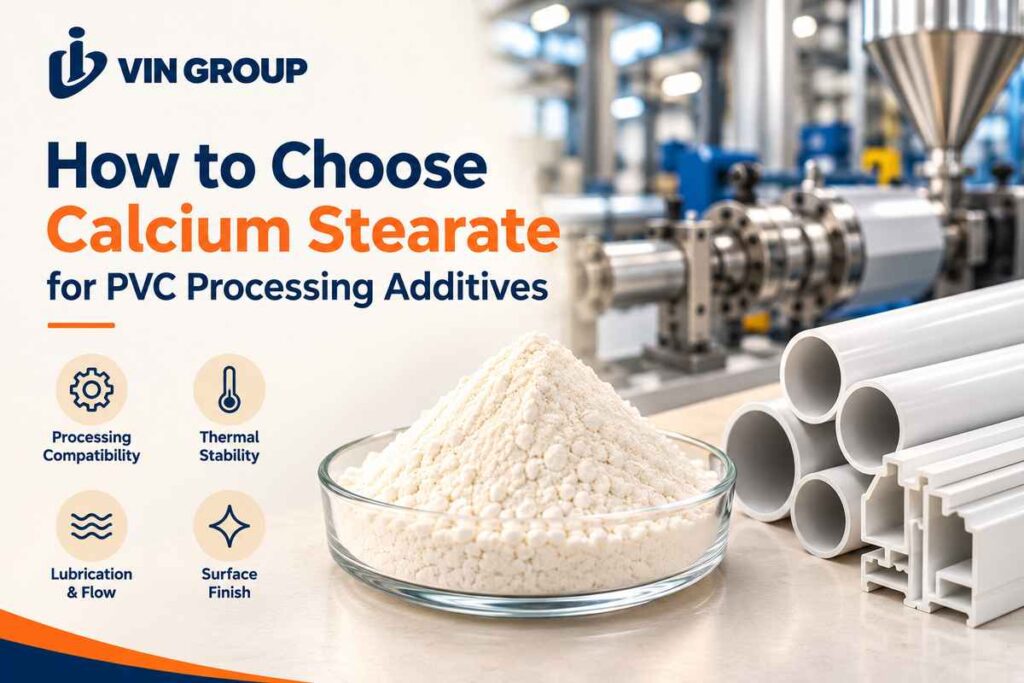
How to Choose Calcium Stearate for PVC Processing Additives
Choosing the right PVC processing additives is essential for improving manufacturing efficiency, maintaining product quality, and achieving consistent results. From PVC pipes and electrical conduits to profiles and fittings, the right additive selection can influence how a PVC compound behaves during processing and the quality of the finished product.
For manufacturers, the goal is to select additives that suit the formulation, processing conditions, and application requirements while maintaining a balance between cost and performance.
What Are PVC Processing Additives?
PVC processing additives are materials incorporated into a PVC formulation to help achieve specific processing or product-performance requirements. Depending on their function, they may support lubrication, fusion, thermal stability, impact performance, or surface quality.
Common categories include:
-
Lubricants: Help manage friction during PVC processing.
-
Heat stabilizers: Help protect PVC from heat-related degradation.
-
Processing aids: Help improve fusion behaviour and processing characteristics.
-
Impact modifiers: Help improve impact resistance in suitable formulations.
-
Fillers and other modifiers: Help achieve specific formulation, performance, or cost objectives.
Each additive serves a different purpose, so selection should be based on the intended application and the complete formulation.
5 Key Factors to Consider When Choosing PVC Processing Additives
1. Processing Compatibility
The first step is to check whether an additive is compatible with your PVC formulation and manufacturing process. Requirements may differ for rigid PVC pipes, electrical conduits, profiles, fittings, and flexible PVC products.
Before selecting an additive, consider the PVC resin grade, stabilizer system, existing lubricants, fillers, and processing equipment. Compatibility testing can help determine whether the additive is suitable for your production requirements.
2. Thermal Stability
PVC can degrade when exposed to excessive heat during processing. Therefore, the thermal stability of the complete formulation is an important consideration.
Evaluate the additive’s suitability for your processing temperature and its interaction with the existing stabilizer system. Appropriate material selection and process control can help maintain product consistency and reduce heat-related defects.
3. Lubrication and Material Flow
Lubrication is an important part of PVC processing, particularly in extrusion and profile manufacturing.
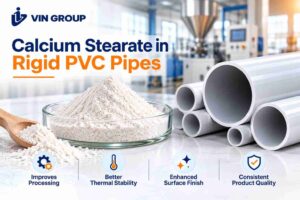
Internal lubricants influence friction within the compound, while external lubricants help manage friction between the material and metal surfaces of processing equipment. The balance between them can affect fusion, material flow, extrusion behaviour, and surface quality.
Manufacturers should evaluate the lubricant balance under actual processing conditions rather than selecting additives based on a single performance claim.
4. Surface Finish and Product Quality
The finished product must meet the quality requirements of its intended application. Manufacturers may need to consider surface smoothness, colour consistency, dimensional stability, and the occurrence of visible defects.
Additives can influence these characteristics, but the final outcome also depends on resin quality, formulation design, equipment settings, and processing conditions. Controlled production trials help assess the overall effect on product quality.
5. Cost and Performance
Choosing an additive based only on its purchase price may not provide the best overall value.
A practical evaluation should consider:
-
Additive dosage and total formulation cost
-
Processing efficiency and production output
-
Product consistency and rejection rates
-
Finished-product quality
-
Compatibility with the existing formulation
Comparing these factors can help manufacturers identify solutions that meet both technical and commercial requirements.
Exploring Calcium Stearate Replacement Solutions for PVC
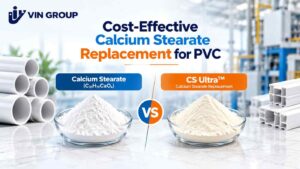
Calcium stearate is used in various PVC formulations for its lubrication-related functions. Manufacturers evaluating alternatives should consider how the replacement affects the overall formulation, processing behaviour, and finished-product properties.
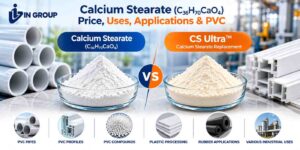
CS Ultra™ by VIN Group is positioned as an advanced, 100% calcium stearate replacement for PVC processing applications.
Manufacturers considering CS Ultra™ should review the available technical documentation and conduct controlled application trials to verify its suitability for their specific formulation and production conditions. Performance should be assessed against defined technical and cost parameters before making changes to an established formulation.
Exploring CS Ultra™: A Calcium Stearate Replacement for PVC
Calcium stearate is used in various PVC formulations for its lubrication-related functions. Manufacturers evaluating alternatives should consider how the replacement affects the overall formulation, processing behaviour, and finished-product properties.
CS Ultra™ by VIN Group is an advanced solution positioned as a 100% calcium stearate replacement for PVC processing applications. It is designed for manufacturers exploring alternative additive solutions for their PVC formulations.
When evaluating CS Ultra™, manufacturers should consider:
- Calcium Stearate Replacement: A solution positioned as a complete replacement for calcium stearate in PVC processing applications.
- Processing Compatibility: Evaluate its suitability for the existing PVC formulation and manufacturing conditions.
- Cost Evaluation: Compare the total additive cost and overall formulation economics.
- Product Quality: Assess the effect on surface finish, processing behaviour and finished-product consistency through controlled trials.
Before changing an established formulation, manufacturers should review the available technical documentation and conduct controlled production trials to verify suitability for their specific requirements.
Looking for a calcium stearate replacement for PVC processing? Explore CS Ultra™ by VIN Group and discuss your formulation requirements with our technical team.
Why Consider CS Ultra™ by VIN Group?
CS Ultra™ provides PVC manufacturers with an alternative to evaluate when reviewing their existing calcium stearate usage. Its suitability should be assessed based on formulation compatibility, processing performance and overall cost-effectiveness.
Contact VIN Group to learn more about CS Ultra™ and explore its suitability for your PVC manufacturing process.
Conclusion
Choosing the right PVC processing additives requires more than comparing product prices. Processing compatibility, thermal stability, lubrication balance, surface finish, and overall cost-performance are all important factors in the selection process.
By evaluating additives against specific manufacturing requirements and conducting appropriate trials, PVC manufacturers can make more informed formulation decisions.
VIN Group offers CS Ultra™ as a calcium stearate replacement solution for PVC processing applications. Contact VIN Group to discuss your requirements and explore whether CS Ultra™ is suitable for your manufacturing process.