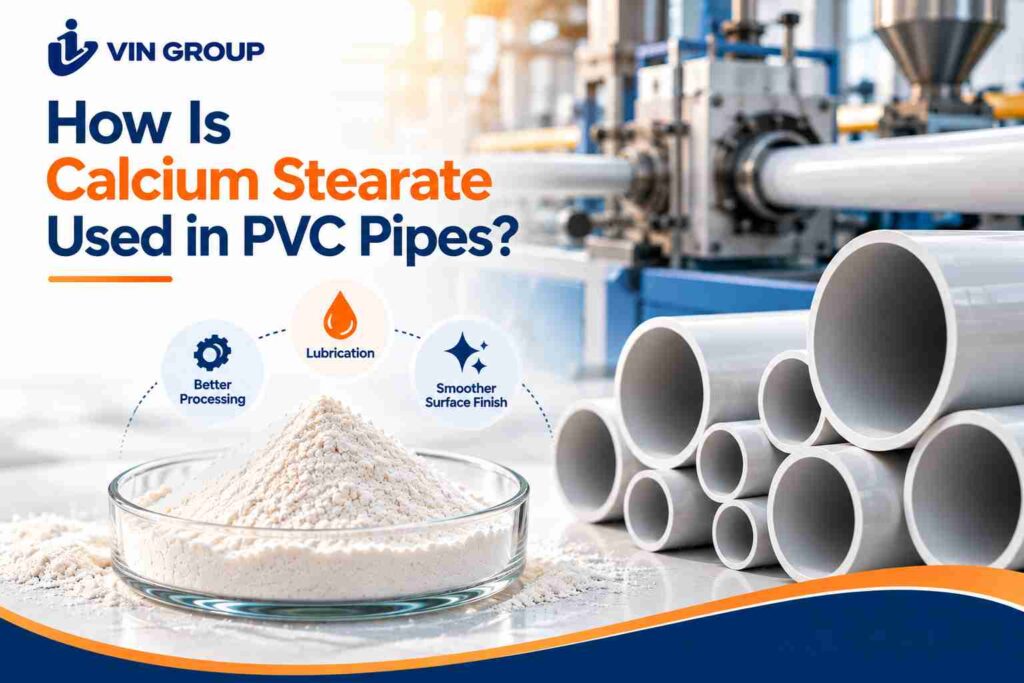
How Is Calcium Stearate Used in PVC Pipes?
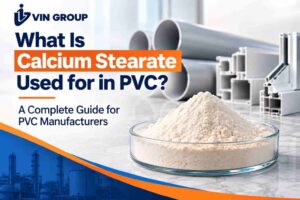
Calcium stearate is widely used in PVC pipe manufacturing as a lubricant and processing aid. It helps control friction during extrusion, supports smoother material flow, improves surface appearance, and contributes to more consistent processing.
But how exactly does calcium stearate work inside a PVC formulation? What role does it play during extrusion, and why do some PVC manufacturers look for alternatives?
This guide explains the practical use of calcium stearate in PVC pipes, its functions, benefits, dosage considerations, and how CS Ultra™ can be evaluated as a calcium stearate replacement for suitable PVC applications.
What Is Calcium Stearate?
Calcium stearate is a calcium salt of stearic acid and is commonly used as a processing additive in plastics.
In PVC manufacturing, it is mainly valued for its lubricating properties. During extrusion, PVC compounds are exposed to heat, pressure, and mechanical shear. Without appropriate lubrication, excessive friction can make processing difficult and may affect the final pipe surface.
Calcium stearate helps manage this friction by providing lubrication within the PVC formulation.
Why Is Calcium Stearate Used in PVC Pipes?
PVC pipe production involves several ingredients, including PVC resin, stabilizers, fillers, pigments, processing aids, and lubricants.
During extrusion, these materials must mix and flow consistently through the processing equipment. Calcium stearate can support this process in several ways.
1. Provides Lubrication
One of the primary functions of calcium stearate is lubrication.
It can help reduce friction between the PVC compound and metal surfaces inside processing equipment. It also contributes to lubrication within the formulation.
This can support smoother extrusion and help manufacturers maintain more consistent processing conditions.
2. Helps Control Processing Friction
PVC compounds experience significant mechanical forces during extrusion.
Excessive friction can contribute to:
- Higher processing resistance
- Uneven material flow
- Surface imperfections
- Processing instability
- Increased equipment stress
Calcium stearate helps control friction so that the PVC compound can move through the extrusion process more smoothly.
3. Supports Better Surface Finish
The surface quality of a PVC pipe is influenced by formulation, extrusion conditions, die design, cooling, and lubrication.
Adequate lubrication can help produce a smoother and more uniform pipe surface.
This is particularly important where the finished pipe requires:
- Smooth appearance
- Consistent dimensions
- Clear product markings
- Uniform surface quality
However, lubrication must be properly balanced because excessive lubricant can also affect processing behavior.
How Does Calcium Stearate Work During PVC Extrusion?
A typical rigid PVC pipe manufacturing process involves several stages:
PVC Formulation → Mixing → Heating → Extrusion → Die Shaping → Cooling → Cutting
Calcium stearate becomes particularly important during the mixing and extrusion stages.
During processing, the PVC compound is heated and subjected to mechanical shear. The lubricant helps manage friction between the compound and processing equipment while supporting the movement of the material through the extruder.
The exact effect depends on the complete formulation rather than calcium stearate alone.
Factors such as:
- PVC resin type
- Filler level
- Stabilizer system
- Processing temperature
- Extrusion speed
- Screw configuration
- Lubricant dosage
can all influence the final result.
Calcium Stearate as an Internal and External Lubricant
Lubricants used in PVC formulations are often discussed in terms of internal and external lubrication.
Internal Lubrication
Internal lubrication helps reduce friction between components within the PVC compound.
This can influence melt flow and processing behavior.
External Lubrication
External lubrication primarily helps reduce adhesion and friction between the PVC melt and metal surfaces of processing equipment.
Calcium stearate can contribute to both lubrication functions, although its exact behavior depends on the formulation and processing conditions.
For rigid PVC pipes, maintaining the correct balance between internal and external lubrication is important.
How Much Calcium Stearate Is Used in PVC Pipes?
There is no single universal dosage that works for every PVC pipe formulation.
The required amount depends on the formulation and manufacturing conditions.
For example, a formulation containing a high level of filler may behave differently from a low-filler formulation. Similarly, changes in stabilizer systems, processing temperatures, resin characteristics, and other lubricants can change the required dosage.
Therefore, manufacturers generally determine the appropriate level through formulation trials and production testing rather than relying on one fixed number.
Important Consideration
Do not increase calcium stearate simply to obtain more lubrication.
An excessive amount can change the processing balance and may negatively affect fusion, melt behavior, surface quality, or other properties.
The goal is to achieve the required lubrication with the lowest practical formulation level that provides consistent processing performance.
What Happens If PVC Has Insufficient Lubrication?
If the lubrication system is not properly balanced, manufacturers may experience processing difficulties.
Possible signs include:
- Increased friction during extrusion
- Poor material flow
- Surface defects
- Processing instability
- Inconsistent pipe appearance
- Higher equipment load
- Difficulty maintaining production conditions
The exact symptoms depend on the complete formulation and processing setup, so lubrication should be evaluated together with other formulation variables.
What Happens If There Is Too Much Lubrication?
More lubricant does not automatically mean better processing.
An excessive lubricant level can disturb the balance between internal and external lubrication.
Depending on the formulation, this may affect:
- PVC fusion
- Melt strength
- Processing stability
- Surface characteristics
- Production consistency
This is why calcium stearate should be optimized rather than simply increased.
Calcium Stearate and PVC Pipe Quality
The role of calcium stearate goes beyond simply making the material easier to process.
A properly balanced lubrication system can contribute to:
Smoother Processing
Helps control friction during extrusion.
Consistent Material Flow
Supports stable movement of the PVC compound through the equipment.
Better Surface Finish
Can contribute to a smoother and more uniform pipe surface.
Processing Control
Helps manufacturers maintain a suitable lubrication balance.
Production Consistency
A well-optimized formulation can support repeatable manufacturing conditions.
It is important to remember that final pipe quality depends on the complete formulation and process—not on calcium stearate alone.
Can Calcium Stearate Be Replaced in PVC Pipe Manufacturing?
Yes, manufacturers can evaluate alternative lubricant and processing-aid systems depending on their formulation requirements and processing conditions.
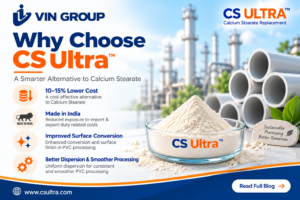
One such option is CS Ultra™, developed by VIN Group as a 100% replacement for Calcium Stearate in suitable PVC applications.
What Is CS Ultra™?
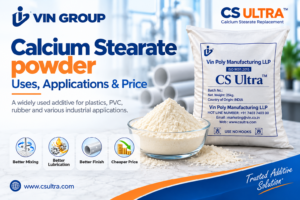
CS Ultra™ is a specially formulated PVC additive developed as a 100% replacement for Calcium Stearate in suitable PVC applications. It is designed to provide lubrication and processing support during PVC manufacturing while helping reduce friction and improve dispersion.
CS Ultra™ works as a lubricant and processing aid, supporting smoother material flow during extrusion. Its formulation is designed to provide lubrication and processing benefits while helping manufacturers achieve consistent PVC processing and surface quality.
Key Benefits of CS Ultra™
CS Ultra™ is designed to provide:
Better Dispersion
Helps promote more uniform distribution of ingredients within the PVC formulation.
Superior Lubrication
Provides lubrication support during PVC processing.
Smoother Processing
Helps reduce friction during PVC extrusion.
Improved Surface Finish
Supports a smoother and more consistent pipe surface.
Lower Production Waste
Consistent processing can help minimize processing-related defects.
Better Marking & Labeling
A smoother pipe surface can support clearer product marking.
CS Ultra™ Product Specifications
| Property | Specification |
|---|---|
| Product | CS Ultra™ |
| Function | Lubricant & Processing Aid |
| Replacement | 100% Calcium Stearate Replacement |
| Physical Form | Powder |
| Appearance | Off-White |
| Compatibility | PVC |
| Country of Origin | India |
Where Can CS Ultra™ Be Used?
CS Ultra™ can be evaluated in suitable PVC applications, including:
- Rigid PVC Pipes
- uPVC Pipes
- Conduit Pipes
- PVC Profiles
- PVC Casing & Capping
- PVC Flooring
- PVC Windows & Doors
- Other suitable PVC formulations
Is CS Ultra™ a Direct Replacement for Calcium Stearate?
CS Ultra™ is developed as a 100% Calcium Stearate replacement for suitable PVC applications.
The recommended dosage can be evaluated against the manufacturer’s existing Calcium Stearate dosage, while the final formulation should be validated through production trials.
Actual dosage and performance may vary depending on:
- PVC resin
- Filler level
- Stabilizer system
- Processing temperature
- Extrusion conditions
- Overall formulation
This makes CS Ultra™ an option for manufacturers looking to evaluate an alternative to conventional Calcium Stearate while maintaining lubrication and processing performance.
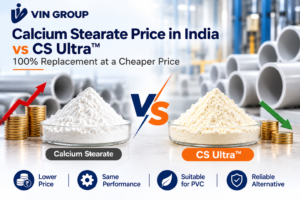
Calcium Stearate vs. Calcium Stearate Replacement
When comparing a conventional calcium stearate formulation with an alternative, manufacturers should not evaluate only the price per kilogram.
A practical comparison should consider:
| Evaluation Factor | What to Check |
|---|---|
| Dosage | Required level in the formulation |
| Lubrication | Internal and external lubrication behavior |
| Dispersion | Uniformity of additives and fillers |
| Processing | Extrusion stability and material flow |
| Surface Finish | Appearance and smoothness of pipe |
| Waste | Defects and rejected production |
| Cost | Total additive cost per production output |
This approach gives a more practical understanding of the economics of a PVC additive.
Where Is Calcium Stearate Used in PVC Applications?
Calcium stearate is used in various PVC formulations, including:
- Rigid PVC pipes
- uPVC pipes
- Conduit pipes
- PVC profiles
- PVC casing and capping
- PVC flooring
- PVC windows and doors
- Other rigid PVC products
The required lubrication system can vary considerably between applications.
Frequently Asked Questions
Is Calcium Stearate Used as a Lubricant in PVC Pipes?
Yes. Calcium stearate is commonly used as a lubricant in PVC formulations and can help control friction during processing.
Does Calcium Stearate Improve PVC Pipe Surface Finish?
It can contribute to improved surface characteristics when the lubrication system is properly balanced. Surface finish also depends on extrusion conditions, formulation, tooling, and cooling.
Can Calcium Stearate Be Used in Rigid PVC?
Yes. Calcium stearate is widely used in rigid PVC formulations, including applications such as PVC pipes and profiles.
Is There a Fixed Calcium Stearate Dosage for PVC Pipes?
No. The appropriate dosage depends on the complete formulation, processing conditions, filler level, stabilizer system, and other additives.
Can Calcium Stearate Be Replaced?
Alternative lubrication and processing systems can be evaluated depending on the PVC formulation. CS Ultra™ is developed as a 100% calcium stearate replacement for suitable PVC applications.
What Is CS Ultra™ Used For?
CS Ultra™ is a PVC additive designed to provide lubrication and processing support. It can be evaluated in PVC pipes, uPVC pipes, conduit pipes, profiles, casing and capping, flooring, windows, doors, and other suitable PVC formulations.
Is CS Ultra™ Suitable for PVC Pipe Manufacturing?
Yes, CS Ultra™ is specifically designed for suitable PVC applications, including PVC pipe manufacturing. Its performance and dosage should be validated according to the specific formulation and processing conditions.
Conclusion
Calcium stearate plays an important lubrication role in PVC pipe manufacturing. It helps manage friction during extrusion, supports material flow, and can contribute to consistent processing and surface quality when properly balanced within the formulation.
However, the lubrication system should be selected according to the specific PVC formulation and production conditions. Manufacturers should consider dosage, dispersion, processing performance, surface finish, production waste, and total additive cost when evaluating calcium stearate or an alternative.
For manufacturers looking to evaluate a calcium stearate replacement for PVC pipes, CS Ultra™ can be tested against the existing formulation under actual production conditions.
Explore CS Ultra™
Calcium Stearate Replacement for PVC
Website: csultra.com
Email: marketing@vin.co.in
Phone: +91 7403 7403 00