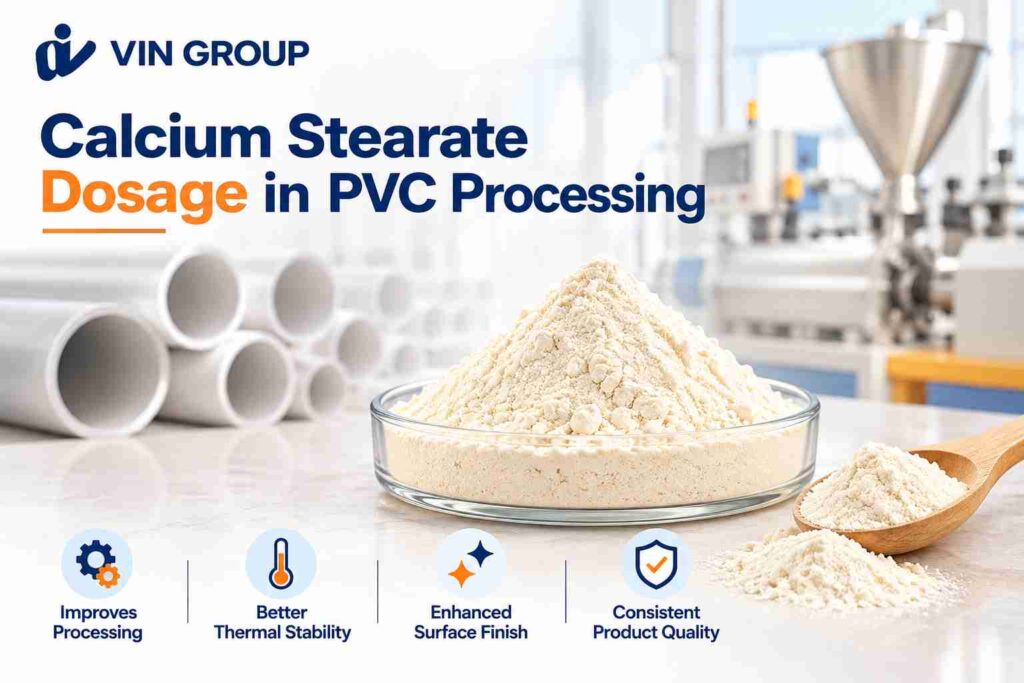
Calcium Stearate Dosage in PVC Processing
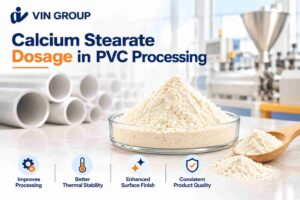
Calcium Stearate is commonly used in PVC processing as a lubricant and processing aid. It can help improve processing behavior, reduce friction and support a smoother surface finish during extrusion. However, the Calcium Stearate dosage in PVC processing is not the same for every formulation.
The suitable dosage depends on the PVC grade, filler level, stabilizer system, other lubricants and processing conditions. For this reason, dosage should be optimized according to the specific formulation and production requirements.
What Is the Role of Calcium Stearate in PVC?
During PVC processing, different ingredients pass through the extrusion system under heat and mechanical shear. Calcium Stearate can contribute to lubrication within the formulation and help manage friction during processing.
It is commonly considered in applications such as:
- Rigid PVC pipes
- UPVC pipes
- PVC profiles
- Conduit pipes
- Windows and door profiles
- Casing and capping
- Other rigid PVC products
The actual effect depends on the complete formulation rather than Calcium Stearate alone.
What Is the Typical Calcium Stearate Dosage in PVC?
There is no single dosage that can be recommended for every PVC formulation. The required level may vary depending on the raw materials, filler loading, stabilizer package, processing equipment and other additives being used.
For an existing production formulation, the most practical approach is to first identify the current Calcium Stearate level and then evaluate processing performance through controlled trials.
Instead of changing the dosage significantly at once, manufacturers can make gradual adjustments and observe:
- Extrusion stability
- Melt processing behavior
- Surface appearance
- Lubrication response
- Production output
- Product quality
This helps identify a suitable level for the particular formulation.
Factors That Affect Calcium Stearate Dosage
1. PVC Resin
The type and grade of PVC resin can influence processing requirements. Different resin characteristics may require different lubrication systems.
2. Filler Loading
Higher filler levels can change the friction and processing behavior of the formulation. The lubricant system may therefore need to be adjusted according to filler content.
3. Other Lubricants
Calcium Stearate is often used together with other internal or external lubricants. The overall balance of the lubricant package is important when determining dosage.
4. Stabilizer System
The stabilizer package can also influence the processing behavior of PVC. Calcium Stearate dosage should therefore be considered as part of the complete formulation.
5. Processing Conditions
Extrusion temperature, screw design, production speed and equipment conditions can affect the performance of the lubricant system.
What Happens if the Dosage Is Too Low?
If the lubrication level is insufficient for a particular formulation, the material may not process as expected. Manufacturers may observe changes in extrusion behavior, surface appearance or processing stability.
However, these symptoms can have multiple causes. Therefore, dosage should not be changed without considering the complete formulation and processing conditions.
What Happens if the Dosage Is Too High?
Excessive lubrication may also affect processing behavior and surface characteristics. The exact result depends on the formulation and the balance between internal and external lubrication.
For this reason, the objective should not simply be to increase or decrease Calcium Stearate. The goal is to find a suitable lubrication balance for consistent production.
How to Optimize Calcium Stearate Dosage
A controlled trial is one of the practical ways to optimize dosage.
Manufacturers can:
- Record the current formulation and Calcium Stearate dosage.
- Keep other raw materials and processing conditions consistent.
- Conduct a controlled trial.
- Compare surface finish, extrusion behavior and product quality.
- Make gradual dosage adjustments if required.
- Select the level that provides consistent processing and acceptable product quality.
This approach reduces unnecessary formulation changes and makes it easier to identify the effect of the lubricant.
Can CS Ultra™ Replace Calcium Stearate?
CS Ultra™ is designed as a 100% replacement for Calcium Stearate in PVC processing applications. It functions as a lubricant and processing aid for applications such as PVC pipes and profiles.
For manufacturers currently using Calcium Stearate, CS Ultra™ can be evaluated using the existing formulation and dosage as the starting point. The actual dosage should be confirmed through a production trial because PVC formulations and processing conditions can vary.
CS ULTRA™ is designed to support better mixing, lubrication and surface finish while offering a lower-price alternative to Calcium Stearate.
Conclusion
The correct Calcium Stearate dosage in PVC processing depends on the complete formulation and production conditions. PVC resin, fillers, stabilizers, other lubricants and extrusion parameters can all influence the required level.
Rather than using one fixed dosage for every application, manufacturers should evaluate dosage through controlled trials and monitor processing and product quality.
For manufacturers looking for an alternative, CS Ultra™ provides a 100% Calcium Stearate replacement option for PVC processing. Contact the CS Ultra™ team to discuss your formulation and request a product sample.
Frequently Asked Questions
What is Calcium Stearate used for in PVC?
Calcium Stearate is used as a lubricant and processing aid in PVC formulations.
Is there a fixed Calcium Stearate dosage for PVC?
No. Dosage can vary according to the formulation, filler level, lubricant system and processing conditions.
Can Calcium Stearate be used in PVC pipes?
Yes, it is used in various rigid PVC applications, including PVC pipes and profiles.
Can CS Ultra™ replace Calcium Stearate?
CS Ultra™ is designed as a 100% replacement for Calcium Stearate. Its suitable dosage should be confirmed through a formulation or production trial.