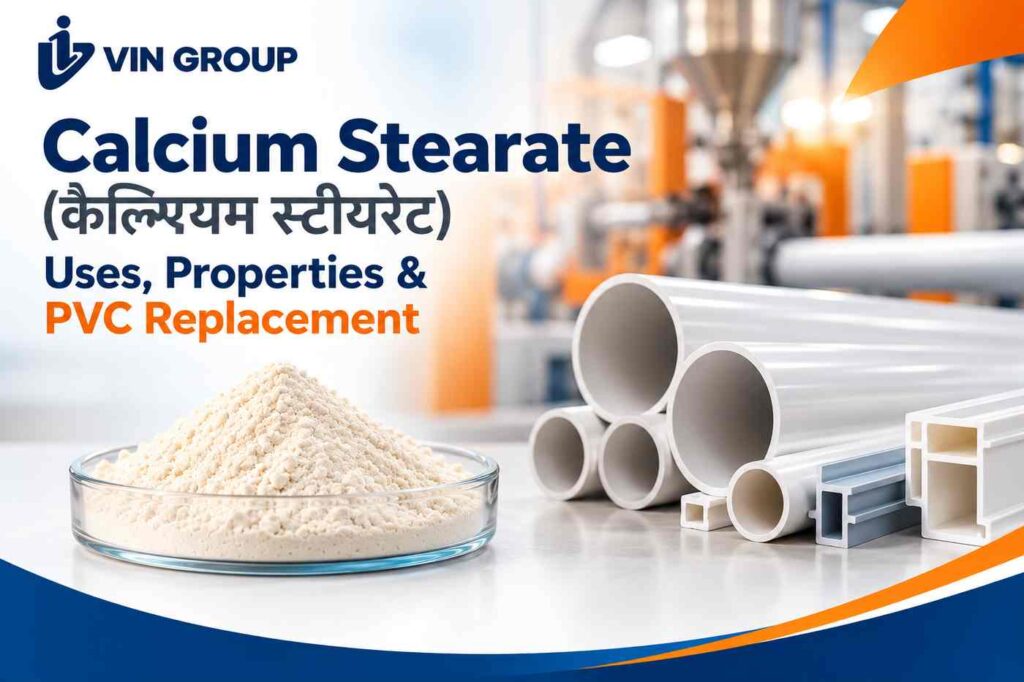
Calcium Stearate (कैल्शियम स्टीयरेट): Uses, Properties, Applications & PVC Replacement
Calcium Stearate (कैल्शियम स्टीयरेट) is a widely used metallic stearate that has applications in plastics, PVC processing, rubber, coatings and other industrial formulations. It is commonly available as a fine powder and is valued for its lubrication, processing-support and release-related properties.
In PVC processing, Calcium Stearate is commonly considered as part of the lubricant system. It can influence processing behaviour, fusion, material flow and surface characteristics depending on the overall formulation.
At the same time, PVC manufacturers may evaluate a Calcium Stearate replacement when looking for an alternative approach to lubrication, dispersion, processing performance or formulation economics.
This guide explains what Calcium Stearate is, its properties and uses, its role in PVC processing, and how a Calcium Stearate replacement for PVC can be properly evaluated.
What Is Calcium Stearate?
Calcium Stearate is the calcium salt of stearic acid and belongs to the family of metallic stearates.
Its commonly referenced chemical information includes:
| Property | Details |
|---|---|
| Chemical Name | Calcium Stearate |
| Hindi Name | कैल्शियम स्टीयरेट |
| Chemical Formula | C₃₆H₇₀CaO₄ |
| CAS Number | 1592-23-0 |
| Molecular Weight | Approximately 607.02 g/mol |
| Physical Form | Fine Powder |
| Chemical Class | Metallic Stearate |
The exact physical properties of commercial Calcium Stearate can vary depending on grade, manufacturing method, purity and application requirements.
Because of its characteristics, Calcium Stearate is used in different industrial formulations where lubrication, processing behaviour, release properties or related functions are required.
Calcium Stearate Uses and Applications
Calcium Stearate is used across several industries. Its specific function depends on the formulation and grade selected.
Common applications include:
Plastics Processing
Calcium Stearate can be incorporated into plastic formulations as a lubricant, processing-support additive or release-related additive.
PVC Processing
It is particularly relevant to rigid PVC formulations, where it can form part of the lubrication system used during extrusion and other processing operations.
Rubber Processing
Certain rubber formulations use Calcium Stearate for processing and release-related purposes.
Construction Materials
Calcium Stearate is also used in some construction-material formulations where water-repellent characteristics are required.
Coatings and Other Formulations
Depending on the grade, Calcium Stearate may be used in coatings, pigments and other industrial applications.
The performance requirements are different for each application, so the appropriate grade should be selected according to the intended use.
Why Is Calcium Stearate Used in PVC?
PVC processing involves heat, shear, pressure and friction.
During extrusion, the PVC compound moves through processing equipment and interacts with metal surfaces, screws and dies. The lubricant system helps control these interactions and influences how the material behaves during processing.
Calcium Stearate can contribute to the overall processing system through:
- Lubrication
- Friction control
- Material flow
- Fusion behaviour
- Processing consistency
- Surface characteristics
However, Calcium Stearate does not work independently.
Its performance can be affected by the PVC resin, stabilizer system, fillers, pigments, other lubricants, processing temperature and equipment configuration.
Calcium Stearate as a PVC Lubricant
One of the key reasons Calcium Stearate is used in PVC is its lubricating function.
PVC formulations can contain both internal and external lubricant components. The balance between these components can influence the relationship between fusion, melt flow and processing behaviour.
Calcium Stearate can therefore be considered as part of the lubricant system rather than as a standalone solution for every processing requirement.
When evaluating a Calcium Stearate-based formulation, manufacturers may monitor:
- Extruder torque
- Processing pressure
- Fusion behaviour
- Melt flow
- Surface appearance
- Production output
- Processing stability
Calcium Stearate in PVC Pipe Manufacturing
PVC pipes are commonly manufactured through an extrusion process.
A simplified production flow is:
PVC Resin → Additive Mixing → Heating → Extrusion → Die Formation → Cooling → Finished Pipe
The additive system used in the formulation can influence the behaviour of the PVC compound throughout this process.
Calcium Stearate may be included in the formulation to contribute to the required lubrication balance.
For PVC pipe manufacturers, important evaluation parameters can include:
Extrusion Pressure
Changes in the lubricant system may affect pressure during extrusion.
Torque
Extruder torque can provide an indication of how the formulation behaves under processing conditions.
Fusion
The balance between lubrication and fusion is important for consistent PVC processing.
Surface Finish
The processing system can influence the final appearance and smoothness of the pipe surface.
Production Output
Processing efficiency can also be considered when comparing additive systems.
Is There a Fixed Calcium Stearate Dosage for PVC?
There is no universal dosage that is appropriate for every PVC formulation.
The required level can depend on:
- PVC resin
- Stabilizer system
- Other lubricants
- Fillers
- Pigments
- Processing equipment
- Processing temperature
- Screw speed
- Product requirements
For this reason, dosage should be established through controlled formulation trials rather than applying one number to every PVC application.
A manufacturer can compare different formulation levels by monitoring torque, pressure, fusion, output, surface finish and finished-product quality.
What Is a Calcium Stearate Replacement?
A Calcium Stearate replacement is an alternative additive that is evaluated to perform the required function of conventional Calcium Stearate within a particular formulation.
In PVC processing, replacement does not simply mean finding another powder and using it at the same amount.
The alternative needs to be evaluated against the requirements of the complete formulation.
A useful evaluation can include:
Lubrication + Dispersion + Fusion + Processing Stability + Surface Finish + Output + Product Quality + Cost
This is why a proper replacement study is more valuable than comparing the two materials only on purchase price.
Why Consider a Calcium Stearate Replacement for PVC?
PVC manufacturers may consider an alternative for different technical or commercial reasons.
1. Processing Optimization
An alternative additive may be evaluated to determine whether it can provide the required processing behaviour under specific production conditions.
2. Lubrication Balance
Changing the lubricant system can provide an opportunity to review the balance between internal and external lubrication.
3. Dispersion
Manufacturers may evaluate whether an alternative supports consistent additive distribution within the PVC formulation.
4. Surface Finish
The alternative can be compared for its effect on finished-product appearance and surface quality.
5. Production Performance
Torque, pressure, fusion, output and processing stability can be compared with the existing formulation.
6. Formulation Economics
The complete cost of the additive system can be evaluated instead of looking only at the price per kilogram.
Can Calcium Stearate Be Directly Replaced?
A direct one-to-one replacement should not be assumed without testing.
Different PVC formulations respond differently to changes in their additive systems.
For example, changing the lubricant system can influence:
- Fusion time
- Extruder torque
- Pressure
- Material flow
- Surface finish
- Processing stability
- Production output
Therefore, the replacement should be tested under controlled conditions.
A practical approach is:
Existing Formulation
↓
Baseline Production Data
↓
Controlled Replacement Trial
↓
Processing Comparison
↓
Finished Product Testing
↓
Cost Evaluation
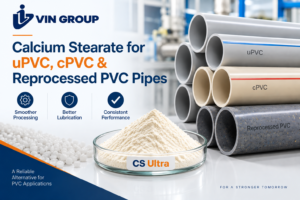
Calcium Stearate Replacement for PVC Pipes
PVC pipe manufacturing is an important application where an alternative to Calcium Stearate may be evaluated.
The replacement should be tested under conditions representative of actual pipe production.
Important parameters include:
| Parameter | What to Evaluate |
|---|---|
| Torque | Extruder load |
| Pressure | Processing behaviour |
| Fusion | Fusion characteristics |
| Output | Production rate |
| Surface | Pipe appearance |
| Stability | Consistency during extrusion |
| Product Quality | Final pipe performance |
The goal is not simply to replace the existing additive.
The goal is to determine whether the replacement can provide the required processing and product performance within the manufacturer’s formulation.
Calcium Stearate Alternative for PVC Processing
The terms Calcium Stearate alternative and Calcium Stearate replacement are often used by manufacturers exploring different additive solutions.
However, the most important question is not:
“Which product has the lowest price?”
The more useful question is:
“Which alternative provides the required performance in my PVC formulation?”
Every PVC formulation can be different.
Resin, stabilizers, fillers, pigments, lubricants, equipment and processing conditions can all influence the result.
Therefore, the same Calcium Stearate replacement may require different evaluation conditions across different PVC products.
What Should Be Tested Before Replacing Calcium Stearate?
A structured trial can reduce the risk of making a formulation change without sufficient data.
Step 1: Record the Current Formulation
Document the existing Calcium Stearate grade, dosage and complete additive package.
Step 2: Establish a Baseline
Record current processing data such as:
- Torque
- Pressure
- Fusion
- Output
- Surface finish
- Processing stability
Step 3: Introduce the Alternative
Test the proposed Calcium Stearate replacement under controlled conditions.
Step 4: Compare Processing Behaviour
Compare the alternative with the existing formulation.
Step 5: Test the Finished Product
Check the required physical, visual and application-specific properties.
Step 6: Evaluate Cost
Compare the overall economics of the two formulations.
This approach provides a more meaningful basis for deciding whether a replacement is suitable.
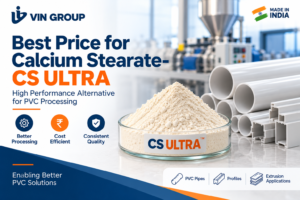
CS Ultra™ – Calcium Stearate Replacement for PVC
CS Ultra™ is positioned as a Calcium Stearate replacement for suitable PVC processing applications.
It is not Calcium Stearate itself. It is an alternative additive intended for evaluation in PVC formulations where manufacturers are considering a replacement for conventional Calcium Stearate.
CS ULTRA™ can be evaluated against an existing Calcium Stearate formulation across several important areas.
Lubrication
Evaluate how the additive contributes to the overall lubrication balance during PVC processing.
Dispersion
Compare additive distribution and processing consistency within the formulation.
Surface Finish
Evaluate the finished PVC product for surface appearance and smoothness.
Processing Stability
Compare torque, pressure, fusion and other relevant production parameters.
Production Output
Evaluate whether the alternative supports the required production rate under comparable conditions.
Cost Optimization
Compare total additive economics based on dosage, material cost and actual processing performance.
Performance and cost benefits should be validated under the specific formulation and processing conditions.
Calcium Stearate vs CS Ultra™
| Parameter | Calcium Stearate | CS Ultra™ |
|---|---|---|
| Product Type | Metallic stearate | Calcium Stearate replacement additive |
| PVC Application | Commonly used in PVC formulations | Designed for suitable PVC processing applications |
| Lubrication | Formulation-dependent | Designed to support PVC processing |
| Dispersion | Formulation-dependent | Can be evaluated for dispersion performance |
| Surface Finish | Formulation-dependent | Can be evaluated for surface finish |
| Replacement | Conventional additive | Calcium Stearate Replacement |
| Evaluation | Existing formulation | Controlled replacement trial |
The comparison should ultimately be based on actual formulation and production data.
How Does a Calcium Stearate Replacement Work?
A replacement additive does not necessarily need to have the same chemical composition as Calcium Stearate.
What matters is whether it can provide the required functional performance within the target formulation.
For PVC processing, the relevant functions may include:
Lubrication → Processing Support → Dispersion → Fusion Balance → Surface Quality
This is why functional testing is more important than comparing chemical names alone.
Benefits of Evaluating a Calcium Stearate Replacement
A structured replacement evaluation can help manufacturers understand whether their current additive system is still the most suitable option for their production requirements.
Potential evaluation areas include:
- Processing efficiency
- Lubrication balance
- Dispersion
- Surface quality
- Production consistency
- Output
- Additive consumption
- Overall formulation economics
The final decision should be based on measured results rather than assumptions.
How to Choose the Right Calcium Stearate Alternative
Before selecting an alternative, manufacturers should consider the following:
Application
Is the product being manufactured from rigid PVC, pipe, profile, fitting, sheet or another application?
Formulation
What resin, stabilizers, fillers, pigments and lubricants are already being used?
Processing Equipment
What type of extruder and processing configuration is being used?
Product Requirements
What surface, dimensional and performance specifications need to be maintained?
Technical Documentation
Does the supplier provide appropriate product specifications and technical information?
Production Trial
Can the alternative be evaluated under controlled production conditions?
Total Economics
Does the alternative provide an acceptable balance of material cost and processing performance?
Common Mistakes When Replacing Calcium Stearate
Replacing Only on Price
A lower price per kilogram does not automatically mean lower overall production cost.
Assuming Equal Dosage
An alternative should not automatically be used at the same dosage without validation.
Ignoring the Complete Formulation
Changing one additive can influence the balance of other formulation components.
Testing Only in the Laboratory
Laboratory results may not always represent full-scale production behaviour.
Ignoring Finished Product Quality
Processing data alone is not enough. The final product should also meet its required specifications.
Frequently Asked Questions
What is Calcium Stearate?
Calcium Stearate is a metallic stearate and the calcium salt of stearic acid, commonly used in plastics, PVC and other industrial formulations.
What is the chemical formula of Calcium Stearate?
The commonly referenced formula is C₃₆H₇₀CaO₄.
What is Calcium Stearate used for in PVC?
It is commonly used as part of the PVC lubricant and processing-additive system and can influence lubrication, fusion and processing behaviour.
Can Calcium Stearate be replaced in PVC?
Yes, an alternative can be evaluated for suitable PVC applications. However, the replacement should be validated through controlled formulation and production trials.
What is the best Calcium Stearate replacement for PVC?
There is no single replacement that is automatically best for every PVC formulation. Suitability depends on the formulation, equipment, processing conditions and product requirements.
What is a Calcium Stearate alternative?
A Calcium Stearate alternative is another additive evaluated to provide the required functional performance of Calcium Stearate within a specific application.
Is CS Ultra™ a Calcium Stearate replacement?
Yes. CS Ultra™ is positioned as a Calcium Stearate replacement for suitable PVC processing applications.
Can Calcium Stearate replacement be used for PVC pipes?
A suitable replacement can be evaluated for PVC pipe applications through controlled extrusion trials and finished-product testing.
Should the same dosage be used for a replacement?
Not automatically. Dosage and formulation should be established through application-specific testing.
Conclusion
Calcium Stearate (कैल्शियम स्टीयरेट) remains an important additive for several industrial applications and is widely relevant to PVC processing.
In PVC, its role is closely associated with the formulation’s lubrication and processing system. However, manufacturers may have different reasons for evaluating a Calcium Stearate replacement, including processing optimization, dispersion, surface finish, production performance and formulation economics.
A successful replacement should not be judged only by price or chemical name. The more reliable approach is to compare lubrication, fusion, dispersion, torque, pressure, surface finish, output, product quality and overall cost under controlled conditions.
CS Ultra™ is positioned as a Calcium Stearate replacement for suitable PVC processing applications and can be evaluated against conventional Calcium Stearate according to the manufacturer’s specific formulation and production requirements.
Explore CS Ultra™
Calcium Stearate Replacement for Suitable PVC Applications
🌐 www.csultra.com
📞 +91 7403 7403 00